
Future controlled thermonuclear reactors (CTR) will produce large quantities of He gas. The nuclear fusion reaction between deuterium (D) and tritium (T) nuclei predicts the generation of a highly-energetic He atom (3.5 MeV) and an additional neutron with around of 14 MeV. Compared to current existing nuclear fission reactors, CTRs will be very aggressive environments for structural materials. Why?
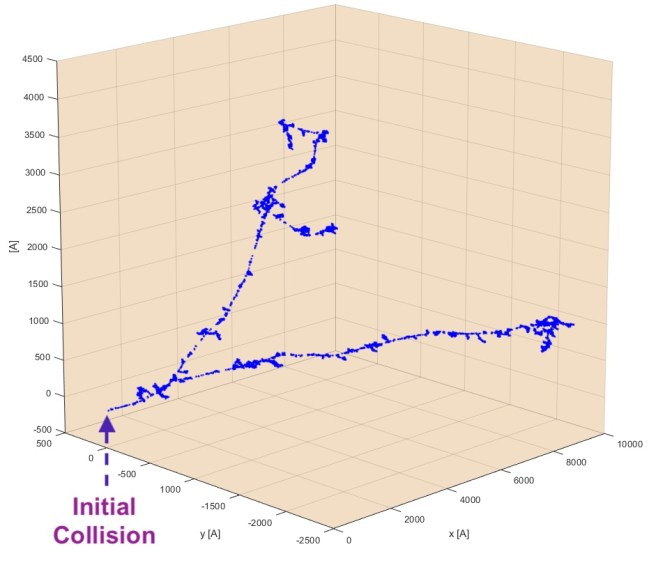
The collision between high-energy neutrons with a Fe-based alloy (e.g. steel) will generate a cascade of vacancies and interstitials that represents the damage induced by such collision: the radiation damage effect. Existing theories and experiments predict that, immediately after the collision, most of the Frenkel pairs will recombine back into a crystalline form, but a considerable part of the punctual defects will survive, thus degrading the pristine material.
Regarding the atomic collisions with He and a structural material, the cascade of defects will be also generated, but with an additional spicy parameter: the association of an He atom with a vacancy is thermodynamically highly favourable. Following this association, upon the arrival of vacancies, He bubbles will nucleate and grow throughout the microstructure. Similarly, upon the departure of vacancies, bubbles will shrink. In the case of the neutron irradiation, voids (picture 2) can be formed in the same way as bubbles. From the point of view of physics, a void can be considered an under-pressurised bubble.
A posed problem for CTR: the bloody He embrittlement.
Voids and bubble are natural obstacles to the motion of dislocation in metals. By hindering the movement of dislocations, He bubbles causes an embrittlement effect in most metallic alloys. Something (an alloy, of course!) that was ductile and had good capability of being mechanically deformed, now it is quite brittle and can experience fracture.
Energetic He atoms and neutrons impinging in the first walls of CTRs will cause embrittlement of the structural materials, thus diminishing the life-expectancy of the controlled thermonuclear fusion reaction! He bubbles can also cause blisters that are associated with an exfoliation effect: where the material starts to lose mass and disintegrate.
Some experts say that we may have operational CTRs by the end of 2030: I am a bit skeptical. We need better radiation-tolerant materials!

Picture 1 and 2: matt tunes own research.
Featured image: BBC London.

 Materials at Extremes