When electron microscopes think for themselves: has China just changed science forever?

A Chinese research team at the Dalian Institute of Chemical Physics has announced what could prove to be a remarkable leap forward in scientific instrumentation: an intelligent transmission electron microscope (TEM) capable of fully autonomous operation. The device, named Yuanyan-1, reportedly harnesses artificial intelligence to overcome longstanding limitations of conventional TEMs, which have depended on … Continue reading When electron microscopes think for themselves: has China just changed science forever?

Grateful to be among the 2025 Rising Stars in Materials Science

I am deeply humbled and grateful to the American Chemical Society and the editors of ACS Materials Au for selecting me as part of the 2025 class of Rising Stars in Materials Science. This recognition came as a wonderful surprise, and I am truly thankful to be included alongside 13 other outstanding early-career researchers from … Continue reading Grateful to be among the 2025 Rising Stars in Materials Science

Prof. Gerhard Sperl: a lifetime connecting metallurgy’s past and present

There are scientists whose work is best understood through instruments, and there are those whose work is best understood through time. Gerhard Sperl – who passed away on Easter Monday, 5 April 2021, at the age of 84 — belonged firmly to the second kind, though he was thoroughly at home with the first. Born … Continue reading Prof. Gerhard Sperl: a lifetime connecting metallurgy’s past and present

New recycling processes or new materials?

The sustainability debate in materials science sometimes asks the wrong questions. How do we recycle more aluminium & steel? These are legitimate — but they treat recyclability/sustainability as an afterthought, forcing materials never designed for circularity back into something useful at considerable cost and energy penalty: facts that Europe, specially, cannot anymore afford. The presence … Continue reading New recycling processes or new materials?

An Humanist Perspective in 2026

Throughout history, humanity has poured its greatest minds, resources, and energy into two competing endeavours — the pursuit of knowledge, and the pursuit of conflict. The choice between them could not be more consequential. War destroys. It consumes lives, erases cultures, and sets civilisations back by generations. Whatever political aims it serves, its legacy is … Continue reading An Humanist Perspective in 2026

New Preprint: Unlocking Nanoscale Detail in Aluminium Alloys with DPC Segmentation

We are pleased to share our latest preprint, now available on arXiv: Unlocking nanoscale microstructural detail in aluminium alloys through differential phase contrast segmentation in STEM (arXiv:2603.11643). In this work, we show how differential phase contrast (DPC) imaging in scanning transmission electron microscopy can be turned into a powerful, quantitative tool for characterising the microstructures … Continue reading New Preprint: Unlocking Nanoscale Detail in Aluminium Alloys with DPC Segmentation

“Seeing” hydrogen embrittlement for the first time at the nanoscale

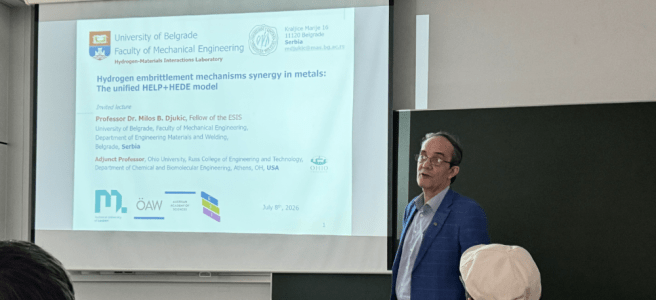
Hydrogen is often celebrated as the clean fuel of the future, but its relationship with metals is far more complicated than it might seem. When hydrogen atoms enter a metal, they can silently weaken it from the inside — a phenomenon known as hydrogen embrittlement — and despite being recognised for over 150 years, the … Continue reading “Seeing” hydrogen embrittlement for the first time at the nanoscale

Atom-by-atom materials shaping future technology

What will the materials powering tomorrow's clean energy systems, quantum computers, and deep-space missions actually be made of — and how do we design them? We are thrilled to share our latest featured article in The European magazine, where we explore how cutting-edge research is engineering matter at the atomic scale. From the nanolaminated MAX … Continue reading Atom-by-atom materials shaping future technology