

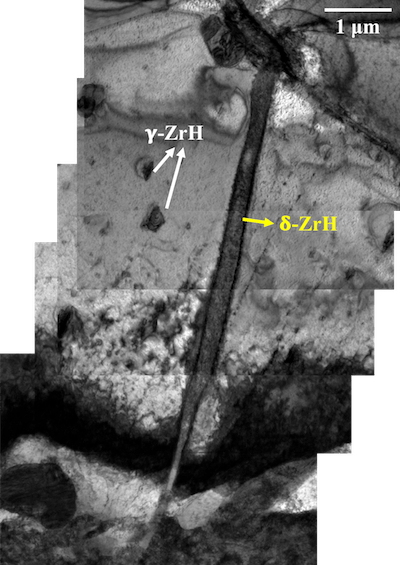
In our most recent scientific manuscript published at the Scripta Materialia (https://goo.gl/WScks9) , zircaloy-4 specimens were H-charged up to 1230 wppmH by using a gas-solid reaction at high temperatures. We have used Electron Energy Loss Spectroscopy (EELS) to analyse the signals from the plasmonic emissions of face-centred cubic Zirconium Hydrides (ZrH): the δ-ZrH phase. The mechanisms of ZrH nucleation, H-uptake and the correlations between their electron energy loss for ZrH at three different site dependencies are discussed. By analysing the calculated electron densities of the valence shells from the measured plasmon energy loss peaks, we have discovered that concentration of H in δ-ZrH is strong dependent on their nucleation site. The use of EELS for fingerprint the different crystals structures within the Zr–H binary phase diagram as previously reported in literature is then questioned.

 Materials at Extremes