
In a paper for Physics Today in August 1969 (one month after Apollo 11 landed on the moon), the Austrian physicist Victor F. Weisskopf described the class of physicists as a bunch of “happy breed of men in a world of uncertainty and bewilderment” [1]. Despite of being an article to increase the ego of scientists, his manuscript is actually a critical view on the role of physicists in our society. It is common sense that physics often deals with so complex problems that sometimes we are detached from human reality and the world around us. I always had such concerns and when I finished my physics degree at the University of São Paulo, I felt a bit lost on the dark without knowing what to do exactly.

I emigrated from the Institute of Physics to the Metallurgical and Materials Sciences Department at the Polytechnic School of the University of São Paulo to carry out a postgraduate research. At that time, I never heard anything about metallurgy and its processes. I was simply not aware: 5 years of physics school is a check-in to your own mind and the laws of physics. The closest knowledge I had was in theoretical condensed matter physics. Of course, one of the biggest concerns of physics is what is matter, how it is organised and behaves down at the atomic level. I was happy to initiate my studies in metallurgy as engineering, a point of contact with reality I never had before.

From a philosophical point of view, I noted that metallurgy has its own aesthetics. In my readings, I came to see a beautiful post-modern realistic painting by the German artist Adolph Menzel: Das Eisenwalzwerk (1872-1875). Menzel pictured metallurgists working in an iron rolling mill. It is difficult sometimes to get full picture and the impressions of an artist from the realism period. For me, Menzel tried to describe the rolling process as several workers and engineers in an apparent synchronized dance. All of them fully concentrated and immersed in the activity. The objective is to achieve a goal of producing a material with a tight range of very specific properties, controlled by precise microstructural modifications. I don’t know whether or not Menzel knew it what was going on there from the science point of view, but the mastery of the moment was captured and translated into art. And it is now perceptualized.
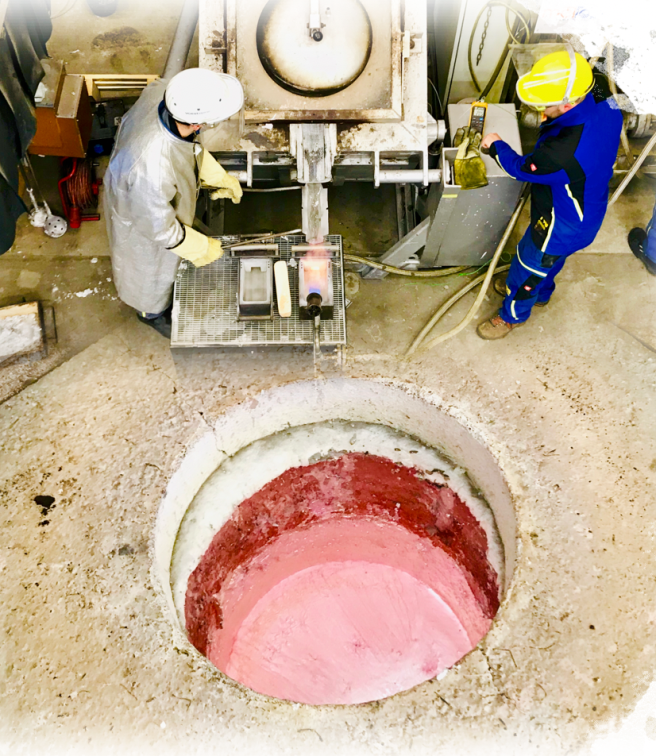
Dear fellow readers: I am telling you this brief and disorganized history to share with you a moment of great happiness I lived today. I am not a painter like Menzel or whatsoever, but I had the wonderful opportunity to see in loco some metallurgists casting an alloy at the Montanuniversität Leoben: a world-class leading university in the field of metallurgy and material sciences in which I am very proud of being part of. I can describe the moment as electrifying, exciting. I have only confirmed the aesthetic impressions that Menzel wanted to give us: metallurgists are very concentrated scientists; they work pretty much synchronized. There is a symbiotic association between the casting material and themselves.
If we physicists are — like Weisskopf described — a bunch of happy man in a world of chaos and sometimes a bit disconnected with our surroundings, the metallurgists are the artists of this world.
[1] Weisskopf, Victor F. “The privilege of being a physicist.” Physics Today 56.2 (2003): 48-53.

 Materials at Extremes