
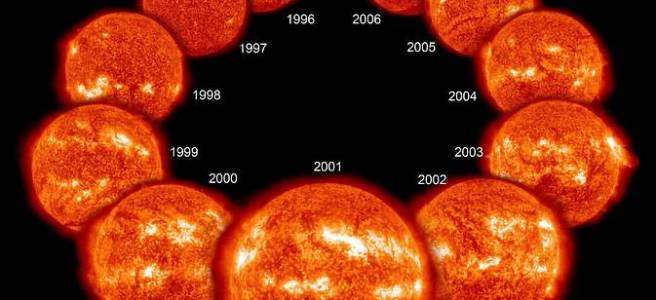
The coming months will test a new prediction that — contrary to most expectations — forecasts one of the strongest solar cycles on record.
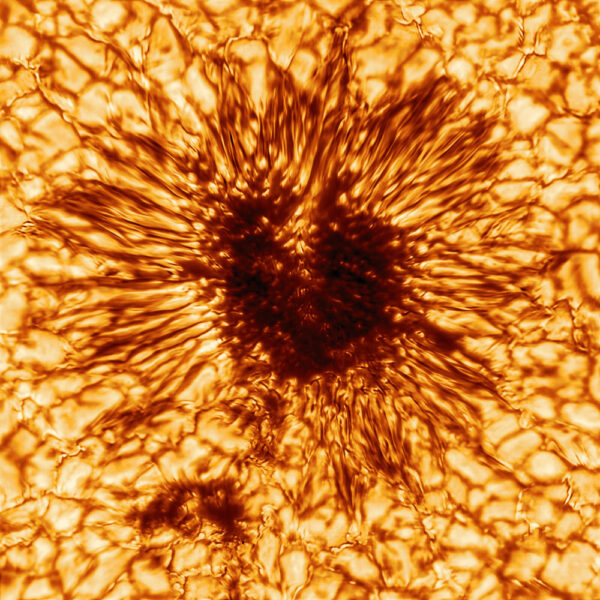
Sunspots are part of an 11-year up-and-down cycle observed since 1610, “one of the oldest data sets that humans have created,” says Dean Pesnell (NASA Goddard), a solar cycle expert. The sunspot cycle is itself just half of the complete magnetic cycle, called the Hale cycle, in which the Sun’s magnetic-field changes come full circle over a period of 22 years.
Just a few months ago, an expert panel of scientists at NASA and the National Oceanic and Atmospheric Administration announced that the beginning of Cycle 25 had occurred in December 2019. That means we’ve hit bottom on sunspot number and are on our way back up, and with sunspots will come all sorts of other magnetically driven activity, like solar eruptions and flares.
But while the timing of the sunspot cycle is relatively predictable, its magnitude isn’t. “The regular up and down in count of sunspot number rarely repeats itself,” Pesnell explains. The inherent turbulence and chaotic nature of the Sun’s dynamo makes predicting its behavior difficult at best. In the end, the panel supported physics-based models, which predict Cycle 25’s activity will be similar to the surprisingly weak Cycle 24, peaking around July 2025 with some 115 sunspots per month.
NSO / AURA / NSF
Full coverage from https://skyandtelescope.org/astronomy-news/how-many-sunspots-will-we-see-in-the-next-solar-cycle/

 Materials at Extremes