A milestone for Ti-based alloys in additive manufacturing

In a great and recent work from my friend Christian Fleißner-Rieger -- doctoral researcher at Montanuniversität Leoben (Austria) -- has shown the discovery of a new and soft martensitic phase in a Ti-based model alloy obtained via additive manufacturing. Such a soft martensitic phase -- which the nucleation can be controlled via processing parameters -- … Continue reading A milestone for Ti-based alloys in additive manufacturing

Discovery of FeCo nanomagnets under irradiation in a high-entropy alloy

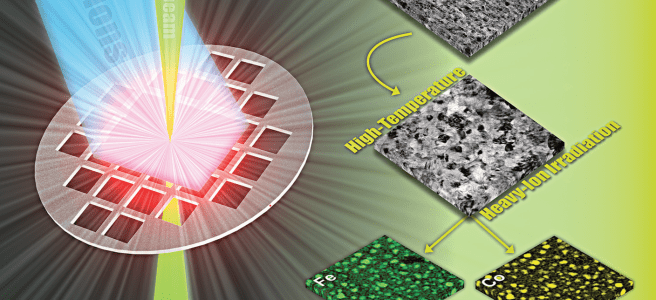
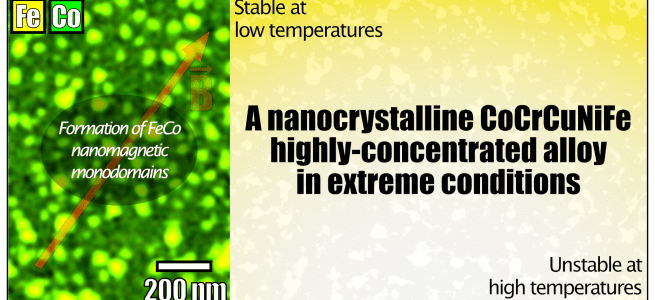
A modified version of the well-known Cantor's alloy, the nanocrystalline CoCrCuFeNi high-entropy alloy was subjected to heavy-ion irradiation in situ within a TEM in our most recent study within the field of potential new nuclear materials. The stability of the alloy was investigated in a broad range of irradiation doses and temperature, revealing the nucleation … Continue reading Discovery of FeCo nanomagnets under irradiation in a high-entropy alloy

Nuclear Materials Biweekly Highlights – #1

We initiate today a new series of posts in the blog targeting an specific niche of the materials at extremes community: the nuclear materials biweekly highlights. In this bimonthly newsletter, we will be covering some special picks of scientific research and development within the nuclear materials community. Obviously, the picks are made by this editor, … Continue reading Nuclear Materials Biweekly Highlights – #1

Key to recycling

From Montanuniversität Leoben: https://www.unileoben.ac.at/en/newsdetail/schluessel-zum-recycling For almost a century, commercial aluminum materials have been developed and optimized for high performance in specific applications within strict chemical confines of industrially established alloy classes. The requirements associated with sustainable lightweighting concepts call for new strategies that offer a broader property portfolio with a better trade-off between formability, achievable … Continue reading Key to recycling

Aluminium Crossover Alloys: an outlook for the future of lightweight metallurgy!

With great happiness and on behalf of my co-authors, we share our just published review paper entitled "On the potential of aluminium crossover alloys", available online on the prestigious journal Progress in Materials Science. A link for free access of our paper can be found here: https://doi.org/10.1016/j.pmatsci.2021.100873 This paper is the consolidation of Dr. Stemper's … Continue reading Aluminium Crossover Alloys: an outlook for the future of lightweight metallurgy!

MATLAB now fully integrated with SRIM!

We have completed -- once and for all -- a full integration of MATLAB with the SRIM code. Now the MATLAB code features the possibility to calculate displacement-per-atoms (DPA) in a wide variety of conditions and using all existing DPA methodologies (R.E. Stoller with quick-damage and Y. Zhang with full cascades). Calculations are performed in … Continue reading MATLAB now fully integrated with SRIM!

On “alien technology” and materials science

We should be categorical here: the question if we are alone in the Universe remains yet unanswered. Nevertheless, several government bodies are now publicizing the issue with enormous coverage by the mass-media, and these facts has also motivated my attention to the problem from a scientific perspective. In a recent public report, the US intelligence … Continue reading On “alien technology” and materials science

The interplay of H in degrading Zr and its alloys

In a recent talk, I address the problem of H in deteriorating severely the properties of the most important metal in nuclear industry, Zr, due to the formation of the Zr hydrides. A throughout good paper H effects in metals was recently written by Professor Milos Djukic, which I highly recommend reading. Abstract The decision … Continue reading The interplay of H in degrading Zr and its alloys

Scientists at Extremes: Interview Series

Stay tuned for the new "Scientists at Extremes: Interview Series" Starting on mid-June 2021! We will be inviting and interviewing scientists from a wide variety of backgrounds related with metallurgy and materials research with special focus on materials under extremes conditions such as (non-exhaustive list): nuclear, corrosion, high-temperatures etc. In the first series, we will … Continue reading Scientists at Extremes: Interview Series