
28/2020Vienna, Austria https://www.iaea.org/newscenter/pressreleases/low-levels-of-radioisotopes-detected-in-europe-likely-linked-to-a-nuclear-reactor-iaea The recent detection of slightly elevated levels of radioisotopes in northern Europe is likely related to a nuclear reactor that is either operating or undergoing maintenance, when very low radioactive releases can occur, the International Atomic Energy Agency (IAEA) said today. The geographical origin of the release has not yet been determined. … Continue reading Nuclear Mystery from IAEA: “Low Levels of Radioisotopes Detected in Europe Likely Linked to a Nuclear Reactor”
Cutting edge Aluminium metallurgy!
Under the supervision of Professor Stefan Pogatscher and in collaboration with a strong scientific network, I am delighted to share our two "most fresh" papers pushing up the frontiers of Aluminium Metallurgy. The first "Age-hardening response of AlMgZn alloys with Cu and Ag additions" is a comprehensive assessment on the heat-treatment response and mechanical properties … Continue reading Cutting edge Aluminium metallurgy!
Life after death?
The modus operandi of science is skepticism. It is indeed! And we scientists should take this very seriously in order to avoid possible mystification during the course our professional life. We are skeptical, although we are allowed to talk about the unknown and try to reach some subjective conclusions based on our own life experiences. … Continue reading Life after death?
History, scientists and metallurgy (1)
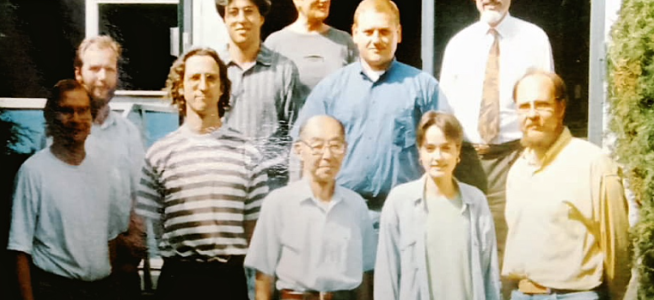
We are starting today in this blog, a series of nostalgic posts on the history of modern metallurgy and its scientists! Please, if you have a photo that you would like to share with us, please don't hesitate to contact me -- matheus.tunes[at]unileoben.ac.at -- and I will be delighted to share with the whole world the … Continue reading History, scientists and metallurgy (1)
An Ode to Metallurgy
In a paper for Physics Today in August 1969 (one month after Apollo 11 landed on the moon), the Austrian physicist Victor F. Weisskopf described the class of physicists as a bunch of "happy breed of men in a world of uncertainty and bewilderment" [1]. Despite of being an article to increase the ego of scientists, his manuscript … Continue reading An Ode to Metallurgy
A giant leap on the fundamental phenomenon of age-hardening in aluminium alloys!
SIZE DEPENDENT AGE-HARDENING DISCOVERED! The Montanuniversitaet Leoben has a small breakthrough to report. The age-hardening of metals was discovered at the beginning of the twentieth century. 110 years later, Phillip Dumitraschkewitz was able to show in his doctoral thesis under supervision of Professor Pogatscher from the Chair of Nonferrous Metallurgy, that the effect depends on the material … Continue reading A giant leap on the fundamental phenomenon of age-hardening in aluminium alloys!
AISI-348: An unstable austenitic stainless steel in particle irradiation environments
In two recent papers, we evaluate the application of the austenitic stainless steel AISI-348 in nuclear reactors. By using advanced electron microscopy techniques, it was found that the austenite phase can be quite unstable in energetic particle environments. Two very good works, don't miss reading them! =]
External Events: how safe a nuclear reactor can be?
The development of nuclear technology has allowed unprecedented progress for mankind. Modern medicine could not be the same without the numerous diagnosis protocols involving the application of concepts and products directly (and indirectly) derived from nuclear engineering. On nuclear reactors, it is unquestionably how cost-competitive, clean, environmentally-friendly and powerful electricity can be generated by using … Continue reading External Events: how safe a nuclear reactor can be?
Highly concentrated alloy coatings: an opportunity for commercialisation of high-entropy alloys
It is now available our latest paper on the use of highly concentrated alloy thin films (HCATF) in nuclear industry. Highly concentrated alloys (HCA) -- sometimes also known as high-entropy alloys (HEA) -- are a recent class of new metallic alloys under investigation for future applications within the nuclear technology (not only here, of course!). … Continue reading Highly concentrated alloy coatings: an opportunity for commercialisation of high-entropy alloys
Huddersfield scientists work with the University of São Paulo engaged on a quest to find materials that can ensure disasters such as the 2011 accident at Japan’s Fukushima Daiichi nuclear power station will not recur.
Share from Uni. of Huddersfield: https://tinyurl.com/y6369ym2 THE University of Huddersfield’s combined electron microscope and ion beam accelerator is a world-class facility responsible for a large and growing global network of research collaborations. One of the latest is a partnership with Brazil’s leading university and the scientific significance of this link and how it could help … Continue reading Huddersfield scientists work with the University of São Paulo engaged on a quest to find materials that can ensure disasters such as the 2011 accident at Japan’s Fukushima Daiichi nuclear power station will not recur.

