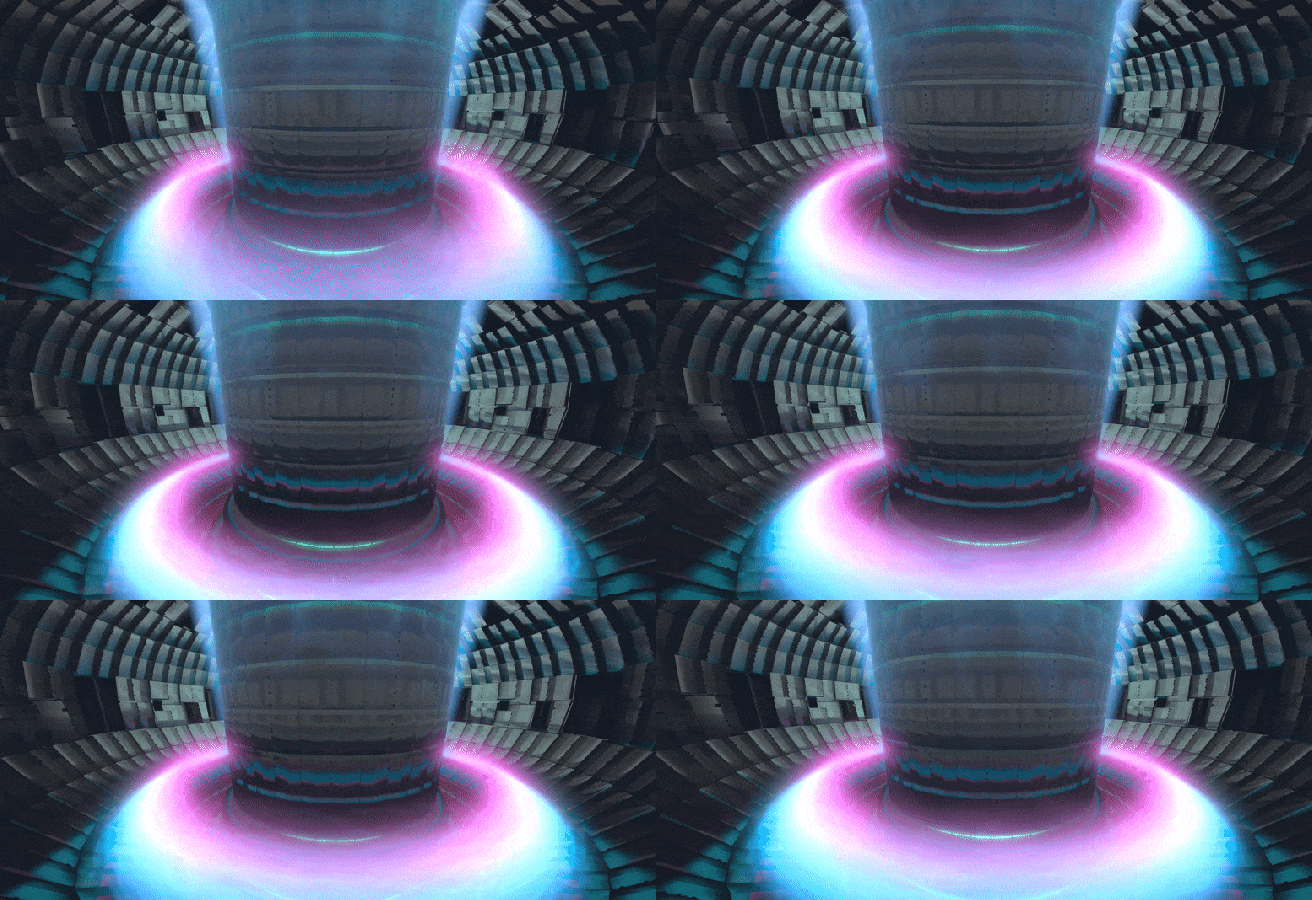
Collaborative Efforts Aim for Lunar Nuclear Power Amidst Materials Challenges

In a groundbreaking move that has sent ripples through the scientific press, Russia and China have announced plans to join forces for an ambitious collaborative space mission. The focal point of this partnership? The installation of nuclear-powered reactors on the surface of the moon by 2035, marking a significant leap forward in humanity's quest for … Continue reading Collaborative Efforts Aim for Lunar Nuclear Power Amidst Materials Challenges

Coal power, definitively not an option!

Fine-particles containing sulfur oxide originating from coal power stations are related to a significant increase in mortality risks. This is a result of a comphreensive study just published at the Science magazine last month. I think it is now clear that we must act to stop further uses of coal as an energy source! HENNEMAN, … Continue reading Coal power, definitively not an option!

Advancing microreactor materials technology: Next stop, the Moon!

Miniaturizing nuclear reactors offers a robust solution for generating reliable and efficient electricity, crucial for supporting human missions beyond Earth. Such miniturization is not at all an easy task. I have been pursuing research in this area since 2015, when we designed a ~ 3x3 metre-sized small nuclear reactor core for biological shielding optimization studies. … Continue reading Advancing microreactor materials technology: Next stop, the Moon!

Consolidating nanocrystalline aluminium crossover alloys for extreme environments

We are re currently exploring nanocrystalline aluminum alloys to understand how they perform in extreme conditions such as energetic particle irradiation and high temperatures. Aluminum alloys are ideal for challenging environments, given their versatility, lightweight nature, and favorable properties. In a recent preprint led by Patrick Willenshofer, we discovered and reported for the first time … Continue reading Consolidating nanocrystalline aluminium crossover alloys for extreme environments

Montanuniversität Leoben highlights its research in Space

On 8th November 2023, the Montanuniversität Leoben hosted a special event to introduce its research and development strategy for Science in Space in collaboration with the European Space Agency. The new rector, Professor Peter Moser, stressed the necessity for new materials as humankind ventures further into space. Professor Moser also mentioned the extreme conditions of … Continue reading Montanuniversität Leoben highlights its research in Space

Metal Hydrides will Enable Space Exploration

I am glad to share with the community our newest paper on the fabrication of pure and bulk delta-phase Zirconium Hydride for use as moderators in microreactors. 50 days' free access here: https://authors.elsevier.com/c/1hv1X_UwYx0wLC Hydride moderators are envisaged for use in nuclear reactors for neutron thermalization, i.e., to reduce the kinetic energy of fast-born neutrons. This … Continue reading Metal Hydrides will Enable Space Exploration

Our candidacy to the ESA’s Facility Definition Team on Materials Science

We have submitted our candidacy to the European Space Agency to integrate the Facility Definition Team (FDT) of Materials Science. We aim at bringing to ESA our expertise in investigating metallurgy for space applications. Our focus is to design new lightweight metallic materials that are capable to resist the harsh environmental conditions often found in … Continue reading Our candidacy to the ESA’s Facility Definition Team on Materials Science

Introducing the Zigzag IntermetAllic (ZIA) phases: A new class of nanostructured materials

With a warm heart, I would like to share with the materials science community our newest preprint on introduction of the "ZIA phases". The ZIA phases further elaborate upon the notion of nanolaminated crystalline solids, extending it significantly beyond the MAX phases lineage of initial transition metal carbides/nitrides. This expansion is highly likely to widen … Continue reading Introducing the Zigzag IntermetAllic (ZIA) phases: A new class of nanostructured materials