
Our interview to Journal da USP is now online, in Portuguese: https://jornal.usp.br/ciencias/liga-metalica-esconde-material-magnetico-com-potencial-para-aprimorar-dispositivos-eletronicos/ A link with an English translation provided by Google is here: https://jornal-usp-br.translate.goog/ciencias/liga-metalica-esconde-material-magnetico-com-potencial-para-aprimorar-dispositivos-eletronicos/?_x_tr_sl=auto&_x_tr_tl=en&_x_tr_hl=en-US
Tag: degradation
Discovery of FeCo nanomagnets under irradiation in a high-entropy alloy
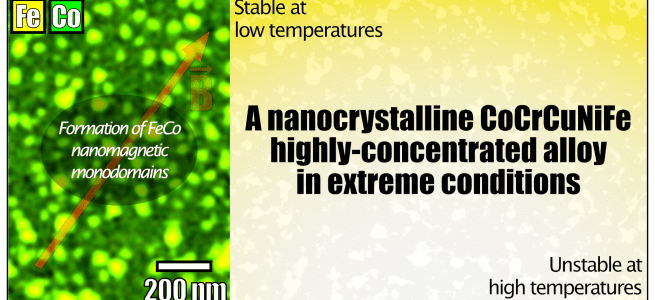
A modified version of the well-known Cantor's alloy, the nanocrystalline CoCrCuFeNi high-entropy alloy was subjected to heavy-ion irradiation in situ within a TEM in our most recent study within the field of potential new nuclear materials. The stability of the alloy was investigated in a broad range of irradiation doses and temperature, revealing the nucleation … Continue reading Discovery of FeCo nanomagnets under irradiation in a high-entropy alloy
Metal Alloy Space Materials!
Read now our recent paper on #Space #Materials! Technology of #aluminium #alloys support human aspirations to conquer the space! Great #collaboration between @HudCompEng @HuddersfieldUni @ETH_en @unileoben @metallurgie_mul Nice cover by @AdvSciNews https://tinyurl.com/SpaceMaterials
Cu nanowire research highlight at USP Newspaper!
Our recent article at npj Materials Degradation was highlighted at the USP Newspaper. Access here (in Portuguese): https://jornal.usp.br/ciencias/de-modo-surpreendente-cientistas-descobrem-nova-forma-de-obter-material-para-industria-eletronica/ https://www.instagram.com/p/CHgU7Lvnq85/
AISI-348: An unstable austenitic stainless steel in particle irradiation environments
In two recent papers, we evaluate the application of the austenitic stainless steel AISI-348 in nuclear reactors. By using advanced electron microscopy techniques, it was found that the austenite phase can be quite unstable in energetic particle environments. Two very good works, don't miss reading them! =]
The history of electronic love between Zirconium and Hydrogen!

In our most recent scientific manuscript published at the Scripta Materialia (https://goo.gl/WScks9) , zircaloy-4 specimens were H-charged up to 1230 wppmH by using a gas-solid reaction at high temperatures. We have used Electron Energy Loss Spectroscopy (EELS) to analyse the signals from the plasmonic emissions of face-centred cubic Zirconium Hydrides (ZrH): the δ-ZrH phase. The mechanisms of ZrH … Continue reading The history of electronic love between Zirconium and Hydrogen!
 Materials at Extremes