Our review article on hydrogen embrittlement and detection
We are excited to share our latest review paper titled "Limitations of Hydrogen Detection After 150 Years of Research on Hydrogen Embrittlement" in the Advanced Engineering Materials. This comprehensive review paper explores a critical challenge in our quest to harness hydrogen as a sustainable energy source—detecting its effects on materials at the nanoatomic level. Hydrogen's … Continue reading Our review article on hydrogen embrittlement and detection
Exploring the Stability of Ti-based MAX Phases in Extreme Nuclear Environments

We are excited to share findings from our latest research on the potential use of MAX phases in nuclear reactors. MAX phases, known for their hexagonal-compact nanolayered crystal structure, high machinability, and chemical inertness, have long been considered promising materials for nuclear applications. However, our new paper sheds light on crucial aspects that must be … Continue reading Exploring the Stability of Ti-based MAX Phases in Extreme Nuclear Environments

Metal Hydrides will Enable Space Exploration

I am glad to share with the community our newest paper on the fabrication of pure and bulk delta-phase Zirconium Hydride for use as moderators in microreactors. 50 days' free access here: https://authors.elsevier.com/c/1hv1X_UwYx0wLC Hydride moderators are envisaged for use in nuclear reactors for neutron thermalization, i.e., to reduce the kinetic energy of fast-born neutrons. This … Continue reading Metal Hydrides will Enable Space Exploration

The influence of He bubble in strengthening of Copper

It is good to see that scientists are working hard to better evaluate the effect of He bubbles in metals and alloys! Sharing a very interesting new article showing unequivocally the influence of He bubbles in the strengthening behavior of Copper! By using shock loading, Lear et al. discovered that He bubbles totally collapse, leaving … Continue reading The influence of He bubble in strengthening of Copper

Amorphous and Refractory High Entropy Alloys

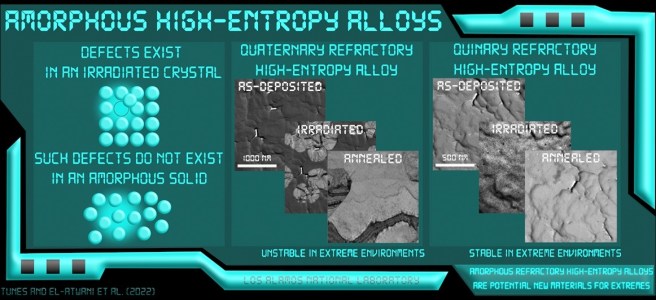
In this very interesting new field of research on refractory amorphous high entropy alloys (RAHEA), we present a case where two different RAHEAs have been synthesized and tested under extreme environments: the WTaCrV and WTaCrVHf. We discuss the parameters that may guide the design and application of these interesting alloys in future nuclear reactors and … Continue reading Amorphous and Refractory High Entropy Alloys

Novel high entropy ceramics for extreme environments

We investigate the radiation response of a hard refractory high entropy carbide (HEC): the (CrNbTaTiW)C. Comparison with the high entropy alloy (HEA) has shown the HEC outperforms the HEA under irradiation. Results suggest high-entropy ceramics can be alternative to HEAs in extreme environments. Available now at Acta Materialia (open access)! Do not forget to see … Continue reading Novel high entropy ceramics for extreme environments

Using the Plasma FIB as a revolutionary tool for studying radiation effects in solids: cover page award!

Our recent work entitled "Rethinking radiation effects in materials science using the plasma-focused ion beam" published in the September issue of the historically prestigious Journal of Materials Science (Springer) has been awarded the cover page of the November 2022 issue (volume 57, number 41). A very nice editorial has been written by Professor C. Barry … Continue reading Using the Plasma FIB as a revolutionary tool for studying radiation effects in solids: cover page award!

Nanocrystalline lightweight alloys for space exploration

We continue in our saga aiming at finding better radiation-resistant materials for applications in the extreme environment of the solar system. I am delighted to introduce you our new paper that was led by Patrick Willenshofer (another genius from Montanuniversitaet Leoben). In this paper, we introduce a revolutionary nanocrystalline crossover aluminium alloy that scored the … Continue reading Nanocrystalline lightweight alloys for space exploration

Investigating the role of electronic energy loss in high-entropy alloys: comparison with ceramics!

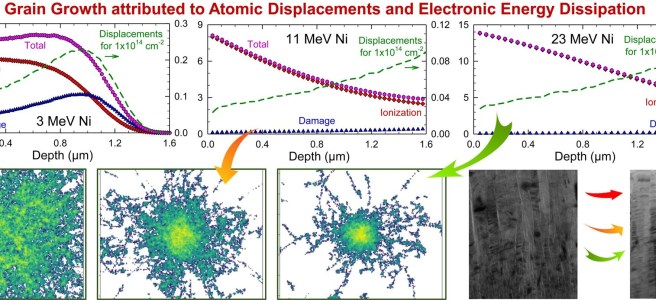
Just sharing with you friends a very interesting research article led by my friend and co-worker, Professor Yanwen Zhang, on the role of electronic energy loss in HEAs. We also do very nice comparison with ceramics! Online now at Current Opinion in Solid State and Materials Science, Elsevier! https://www.sciencedirect.com/science/article/pii/S1359028622000213