Aluminum crossover alloys are an emerging class of materials designed to deliver a broad and balanced combination of mechanical strength, corrosion resistance, and formability. By blending the characteristics of traditional alloy families - 5xxx and 7xxx series alloys - they open new possibilities for high-performance applications in transportation, energy, and structural components. This versatility also … Continue reading Unlocking processability of recycled crossover aluminium alloys
Tag: materials science
Energising the AI Era and Beyond with Nuclear Microreactors
Feature image credits: Westinghouse’s eVinci microreactor, a cross-section of which is shown here, is one of two microreactors that will be tested by the U.S. Department of Energy. Westinghouse Electric Company. The race to meet the soaring energy demands of AI technologies and data centres is driving innovation at an unprecedented pace. One of the … Continue reading Energising the AI Era and Beyond with Nuclear Microreactors
Our work featured in the “Advanced Best of 2025” collection by Wiley!
Happy Easter to our friends all over the world! We are delighted to share that our recent publication, “Limitations of Hydrogen Detection After 150 Years of Research on Hydrogen Embrittlement”, has been selected for inclusion in the prestigious “Advanced Best of 2025” Collection by Wiley. The Advanced Portfolio from Wiley is a renowned family of high-impact journals, publishing cutting-edge research … Continue reading Our work featured in the “Advanced Best of 2025” collection by Wiley!
Aluminium + Diamond-Like Carbon for Next-Gen Hydrogen Fuel Cells
Our latest study just dropped as a preprint on the SSRN server: Is Nitrogen Doping of Diamond-Like Carbon Films a Viable Strategy for Bipolar Plates in Proton Exchange Membrane Fuel Cells? 💡 In this work, we challenge the idea that nitrogen doping improves Diamond-Like Carbon (DLC) coatings. Using a combination of electrochemical testing, electron microscopy, … Continue reading Aluminium + Diamond-Like Carbon for Next-Gen Hydrogen Fuel Cells
Revolutionary Findings in Nonferrous Metallurgy for Fusion Technology
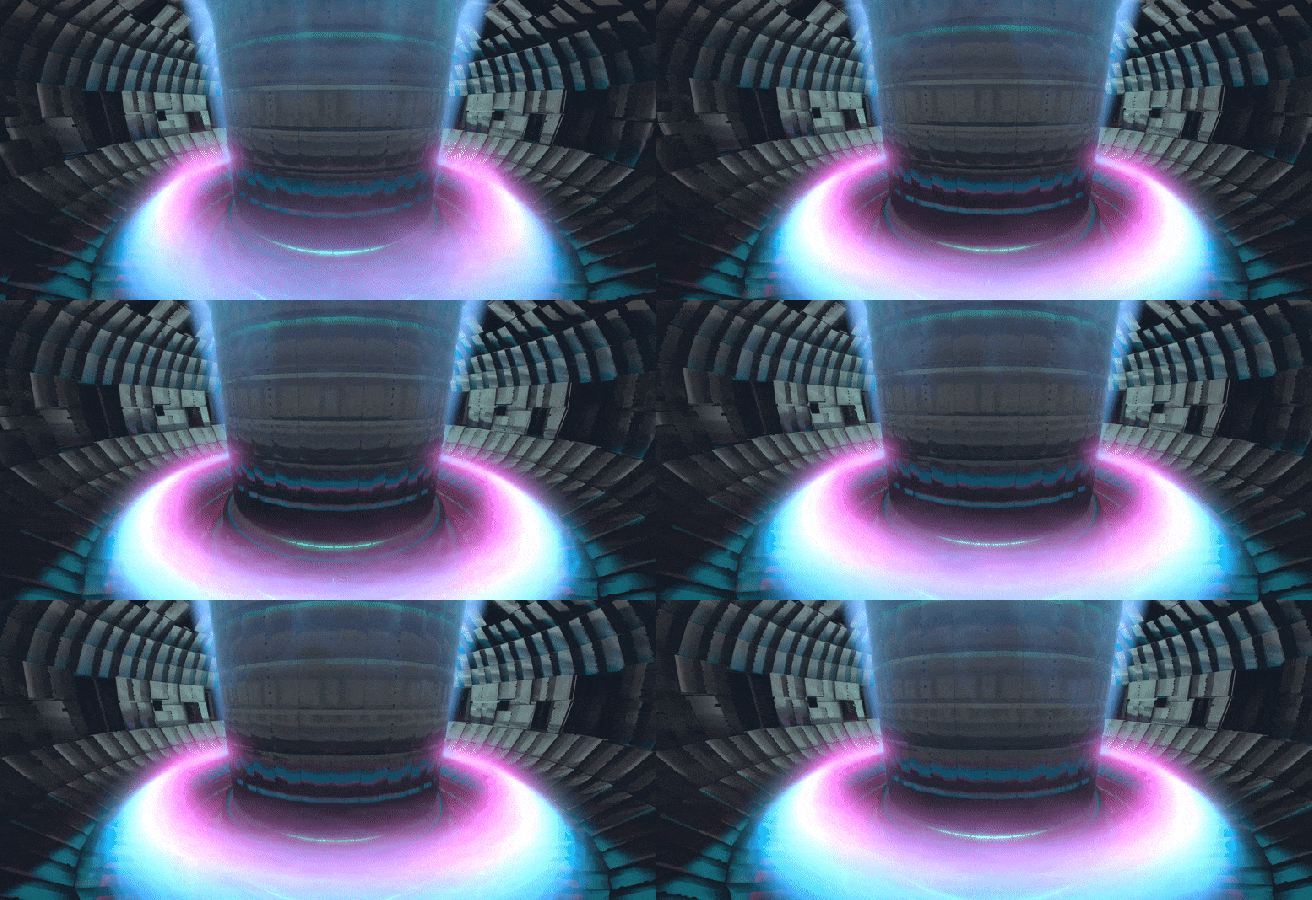
03/20/2025 The [X-MAT] research team from the Chair of Nonferrous Metallurgy, in collaboration with international partners, has made a significant breakthrough in the development of radiation-resistant materials for nuclear fusion reactors. Their latest study, published in Advanced Science (DOI: 10.1002/advs.202417659), challenges conventional high-entropy alloy (HEA) concept by demonstrating that reduced chemical complexity can still achieve … Continue reading Revolutionary Findings in Nonferrous Metallurgy for Fusion Technology
Investigating Hydrogen Embrittlement to Develop Superior Functional Alloys – Prof. Dr. Livia C. Malheiros (UK)
Hydrogen embrittlement (HE) remains a critical challenge in materials engineering, particularly for industries reliant on high-performance metals, such as energy and transportation. As hydrogen atoms diffuse into metals, they weaken the material’s structural integrity, leading to reduced load-bearing capacity and increased brittleness. A deeper understanding of hydrogen’s interactions with metal lattice structures, defects, and stress … Continue reading Investigating Hydrogen Embrittlement to Develop Superior Functional Alloys – Prof. Dr. Livia C. Malheiros (UK)
A great scientific debate: Are clusters or Guinier-Preston zones responsible for strengthening an Al-Cu-Mg alloy?
Feature image credits: https://www.scienceisweird.com/arguing-comics Science thrives on debate, and the historic clash between Ringer et al. and Zahra et al. over the role of solute clustering in Al-Cu-Mg alloys is a perfect example of how scientific disputes drive progress. In this case, one side argued that Cu-Mg clusters were a distinct strengthening mechanism, while the … Continue reading A great scientific debate: Are clusters or Guinier-Preston zones responsible for strengthening an Al-Cu-Mg alloy?
The Call of Science: A Commitment to Humanity in Uncertain Times
In the coming weeks, humanity enters a pivotal chapter. History has shown us similar moments of uncertainty and extremes, and as scientists, we must prepare to navigate these challenges. In times of uncertanties, when the world seems to shift beneath our feet, the role of science becomes indispensable. Scientists are more than seekers of knowledge; … Continue reading The Call of Science: A Commitment to Humanity in Uncertain Times
Our Paper Featured in the “Best of Advanced Engineering Materials 2024”
We are thrilled to announce that our paper, “Limitations of hydrogen detection after 150 years of research on hydrogen embrittlement”, has been selected as one of the standout contributions in the Advanced Engineering Materials 2024 Virtual Issue. This special virtual collection, curated and selected by the Journal Editors, highlights some of the most exceptional research … Continue reading Our Paper Featured in the “Best of Advanced Engineering Materials 2024”
Andreas Weidinger: Pushing the Boundaries of Aluminium Alloy Research
We are thrilled to spotlight the remarkable work of Andreas Weidinger, a doctoral researcher in the Chair of Nonferrous Metallurgy at Montanuniversität Leoben. Currently a visiting scholar at Chalmers University in Sweden, Andreas is making waves in the Swedish lands with his innovative research on aluminum alloys. His groundbreaking work with 5/7 crossover aluminum alloy … Continue reading Andreas Weidinger: Pushing the Boundaries of Aluminium Alloy Research