Montanuniversität Leoben highlights its research in Space

On 8th November 2023, the Montanuniversität Leoben hosted a special event to introduce its research and development strategy for Science in Space in collaboration with the European Space Agency. The new rector, Professor Peter Moser, stressed the necessity for new materials as humankind ventures further into space. Professor Moser also mentioned the extreme conditions of … Continue reading Montanuniversität Leoben highlights its research in Space

Metal Hydrides will Enable Space Exploration

I am glad to share with the community our newest paper on the fabrication of pure and bulk delta-phase Zirconium Hydride for use as moderators in microreactors. 50 days' free access here: https://authors.elsevier.com/c/1hv1X_UwYx0wLC Hydride moderators are envisaged for use in nuclear reactors for neutron thermalization, i.e., to reduce the kinetic energy of fast-born neutrons. This … Continue reading Metal Hydrides will Enable Space Exploration

Our candidacy to the ESA’s Facility Definition Team on Materials Science

We have submitted our candidacy to the European Space Agency to integrate the Facility Definition Team (FDT) of Materials Science. We aim at bringing to ESA our expertise in investigating metallurgy for space applications. Our focus is to design new lightweight metallic materials that are capable to resist the harsh environmental conditions often found in … Continue reading Our candidacy to the ESA’s Facility Definition Team on Materials Science

Introducing the Zigzag IntermetAllic (ZIA) phases: A new class of nanostructured materials

With a warm heart, I would like to share with the materials science community our newest preprint on introduction of the "ZIA phases". The ZIA phases further elaborate upon the notion of nanolaminated crystalline solids, extending it significantly beyond the MAX phases lineage of initial transition metal carbides/nitrides. This expansion is highly likely to widen … Continue reading Introducing the Zigzag IntermetAllic (ZIA) phases: A new class of nanostructured materials

A New Era Beckons: The Epoch of Nanometallurgy

Casting metallic alloys is a primary human activity since the ancient times. Now, by using advanced methods of electron microscopy coupled with the advent of micro-electromechanical devices (MEMS), Diego Coradini and Professor Stefan Pogatscher led a scientific team to a study that demonstrates the feasibility to cast metallic alloys at the nanoscale. Coradini et al. … Continue reading A New Era Beckons: The Epoch of Nanometallurgy

Maximizing corrosion resistance of aerospace aluminium with self-healing coatings

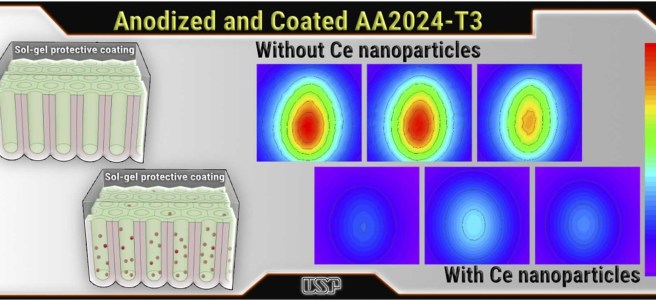
The use of sol-gel coatings to increase the corrosion resistance of commercial aerospace aluminium alloys is the topic of our most-recent paper at Corrosion Science. In combination with anodization treatment and the use of Ce nanoparticles to fill-in the pores of the anodic layer, we have observed that a post-treatment with sol-gel coatings further increases … Continue reading Maximizing corrosion resistance of aerospace aluminium with self-healing coatings

The influence of He bubble in strengthening of Copper

It is good to see that scientists are working hard to better evaluate the effect of He bubbles in metals and alloys! Sharing a very interesting new article showing unequivocally the influence of He bubbles in the strengthening behavior of Copper! By using shock loading, Lear et al. discovered that He bubbles totally collapse, leaving … Continue reading The influence of He bubble in strengthening of Copper

New H-based materials for use in micro-nuclear-reactors

We just got a preprint available in arXiv.org for the general audience: "Fabrication of bulk delta-phase Zirconium Hydride from Zircaloy-4 for use as moderators in microreactors" (arXiv:2305.02249v1) In this manuscript, we performed a complete electron-microscopy characterization of the delta-phase Zirconium Hydride (delta-ZrH) currently under manufacturing, research and development to be used as moderator materials in … Continue reading New H-based materials for use in micro-nuclear-reactors

Amorphous and Refractory High Entropy Alloys

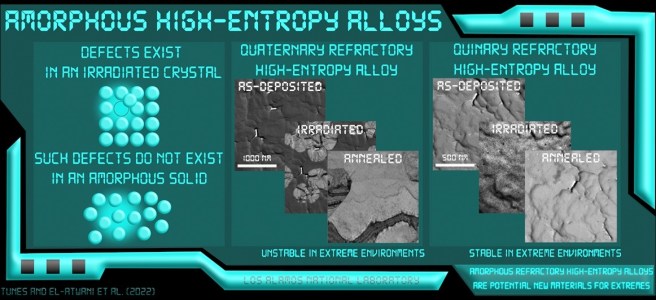
In this very interesting new field of research on refractory amorphous high entropy alloys (RAHEA), we present a case where two different RAHEAs have been synthesized and tested under extreme environments: the WTaCrV and WTaCrVHf. We discuss the parameters that may guide the design and application of these interesting alloys in future nuclear reactors and … Continue reading Amorphous and Refractory High Entropy Alloys