Energising the AI Era and Beyond with Nuclear Microreactors

Feature image credits: Westinghouse’s eVinci microreactor, a cross-section of which is shown here, is one of two microreactors that will be tested by the U.S. Department of Energy. Westinghouse Electric Company. The race to meet the soaring energy demands of AI technologies and data centres is driving innovation at an unprecedented pace. One of the … Continue reading Energising the AI Era and Beyond with Nuclear Microreactors

2024 Retrospective: Advancing Materials for Extreme Environments through X-MAT

At the Chair of Nonferrous Metallurgy, the [X-MAT] team has had an extraordinary year, delivering transformative insights into materials science for extreme environments. From enabling portable power for space missions to improving sustainable energy solutions and advancing future fusion-based nuclear technologies, our work continues to push the boundaries of what materials can achieve. This retrospective … Continue reading 2024 Retrospective: Advancing Materials for Extreme Environments through X-MAT

Our review article on hydrogen embrittlement and detection

We are excited to share our latest review paper titled "Limitations of Hydrogen Detection After 150 Years of Research on Hydrogen Embrittlement" in the Advanced Engineering Materials. This comprehensive review paper explores a critical challenge in our quest to harness hydrogen as a sustainable energy source—detecting its effects on materials at the nanoatomic level. Hydrogen's … Continue reading Our review article on hydrogen embrittlement and detection

MATDPA: Integration of SRIM2013 into MATLAB for nuclear materials calculations

I am happy to announce that the first public version of MATDPA is now available on GITHUB for public download. MATDPA is a collection of MATLAB scripts that I wrote to speed-up and automatize nuclear materials irradiation calculations. To install MATDPA in your machine (only Windows because Apple does not allow to run WINE anymore!), … Continue reading MATDPA: Integration of SRIM2013 into MATLAB for nuclear materials calculations

Professor Yanwen Zhang to join Queen’s University as a Canada Excellence Research Chair

Congratulations to Professor Yanwen Zhang on her appointment as the next Canada Excellence Research Chair for the Impact of Radiation in Energy and Advanced Technologies at Queen's University. As long-standing collaborators, we are proud to see her continue developing leading the next materials science for extreme environments! The team at materialsatextremes.com wishes her all the … Continue reading Professor Yanwen Zhang to join Queen’s University as a Canada Excellence Research Chair

Exploring the Stability of Ti-based MAX Phases in Extreme Nuclear Environments

We are excited to share findings from our latest research on the potential use of MAX phases in nuclear reactors. MAX phases, known for their hexagonal-compact nanolayered crystal structure, high machinability, and chemical inertness, have long been considered promising materials for nuclear applications. However, our new paper sheds light on crucial aspects that must be … Continue reading Exploring the Stability of Ti-based MAX Phases in Extreme Nuclear Environments

Collaborative Efforts Aim for Lunar Nuclear Power Amidst Materials Challenges

In a groundbreaking move that has sent ripples through the scientific press, Russia and China have announced plans to join forces for an ambitious collaborative space mission. The focal point of this partnership? The installation of nuclear-powered reactors on the surface of the moon by 2035, marking a significant leap forward in humanity's quest for … Continue reading Collaborative Efforts Aim for Lunar Nuclear Power Amidst Materials Challenges

New H-based materials for use in micro-nuclear-reactors

We just got a preprint available in arXiv.org for the general audience: "Fabrication of bulk delta-phase Zirconium Hydride from Zircaloy-4 for use as moderators in microreactors" (arXiv:2305.02249v1) In this manuscript, we performed a complete electron-microscopy characterization of the delta-phase Zirconium Hydride (delta-ZrH) currently under manufacturing, research and development to be used as moderator materials in … Continue reading New H-based materials for use in micro-nuclear-reactors

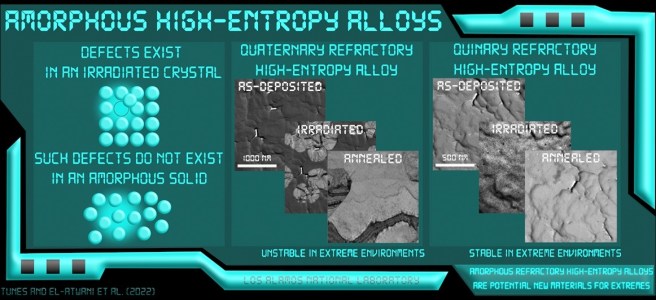
Amorphous and Refractory High Entropy Alloys

In this very interesting new field of research on refractory amorphous high entropy alloys (RAHEA), we present a case where two different RAHEAs have been synthesized and tested under extreme environments: the WTaCrV and WTaCrVHf. We discuss the parameters that may guide the design and application of these interesting alloys in future nuclear reactors and … Continue reading Amorphous and Refractory High Entropy Alloys

Novel high entropy ceramics for extreme environments

We investigate the radiation response of a hard refractory high entropy carbide (HEC): the (CrNbTaTiW)C. Comparison with the high entropy alloy (HEA) has shown the HEC outperforms the HEA under irradiation. Results suggest high-entropy ceramics can be alternative to HEAs in extreme environments. Available now at Acta Materialia (open access)! Do not forget to see … Continue reading Novel high entropy ceramics for extreme environments