The material that could enable permanent human settlement on the moon

Featured image credits: Galileo orbiter spacecraft, NASA/JPL. Nuclear engineering, a remarkable creation of the human mind, has brought essential technological advancements since the dawn of the modern era. Innovations like nuclear reactors, complex thermohydraulic machines that fully harness the power of the atom, provide humanity with electricity — direct benefits born from decades of research … Continue reading The material that could enable permanent human settlement on the moon

Radiation shielding for nuclear-fission powered human-based Mars missions

As multinational space programs progress towards establishing permanent human settlements beyond Earth, radiation shielding and damage continue to pose significant challenges. A fascinating recent paper discussing radiation shielding in the context of future nuclear-fission-powered Mars missions has been published in Nuclear Science and Technology Open Research. Bendoyro AC, Thomas LD, Cassibry J and Emrich W. … Continue reading Radiation shielding for nuclear-fission powered human-based Mars missions

Our review article on hydrogen embrittlement and detection

We are excited to share our latest review paper titled "Limitations of Hydrogen Detection After 150 Years of Research on Hydrogen Embrittlement" in the Advanced Engineering Materials. This comprehensive review paper explores a critical challenge in our quest to harness hydrogen as a sustainable energy source—detecting its effects on materials at the nanoatomic level. Hydrogen's … Continue reading Our review article on hydrogen embrittlement and detection

Professor Yanwen Zhang to join Queen’s University as a Canada Excellence Research Chair

Congratulations to Professor Yanwen Zhang on her appointment as the next Canada Excellence Research Chair for the Impact of Radiation in Energy and Advanced Technologies at Queen's University. As long-standing collaborators, we are proud to see her continue developing leading the next materials science for extreme environments! The team at materialsatextremes.com wishes her all the … Continue reading Professor Yanwen Zhang to join Queen’s University as a Canada Excellence Research Chair

Exploring the Stability of Ti-based MAX Phases in Extreme Nuclear Environments

We are excited to share findings from our latest research on the potential use of MAX phases in nuclear reactors. MAX phases, known for their hexagonal-compact nanolayered crystal structure, high machinability, and chemical inertness, have long been considered promising materials for nuclear applications. However, our new paper sheds light on crucial aspects that must be … Continue reading Exploring the Stability of Ti-based MAX Phases in Extreme Nuclear Environments

Coal power, definitively not an option!

Fine-particles containing sulfur oxide originating from coal power stations are related to a significant increase in mortality risks. This is a result of a comphreensive study just published at the Science magazine last month. I think it is now clear that we must act to stop further uses of coal as an energy source! HENNEMAN, … Continue reading Coal power, definitively not an option!

The influence of He bubble in strengthening of Copper

It is good to see that scientists are working hard to better evaluate the effect of He bubbles in metals and alloys! Sharing a very interesting new article showing unequivocally the influence of He bubbles in the strengthening behavior of Copper! By using shock loading, Lear et al. discovered that He bubbles totally collapse, leaving … Continue reading The influence of He bubble in strengthening of Copper

New H-based materials for use in micro-nuclear-reactors

We just got a preprint available in arXiv.org for the general audience: "Fabrication of bulk delta-phase Zirconium Hydride from Zircaloy-4 for use as moderators in microreactors" (arXiv:2305.02249v1) In this manuscript, we performed a complete electron-microscopy characterization of the delta-phase Zirconium Hydride (delta-ZrH) currently under manufacturing, research and development to be used as moderator materials in … Continue reading New H-based materials for use in micro-nuclear-reactors

Novel high entropy ceramics for extreme environments

We investigate the radiation response of a hard refractory high entropy carbide (HEC): the (CrNbTaTiW)C. Comparison with the high entropy alloy (HEA) has shown the HEC outperforms the HEA under irradiation. Results suggest high-entropy ceramics can be alternative to HEAs in extreme environments. Available now at Acta Materialia (open access)! Do not forget to see … Continue reading Novel high entropy ceramics for extreme environments

A decade probing the radiation response of Ti-based MAX phases

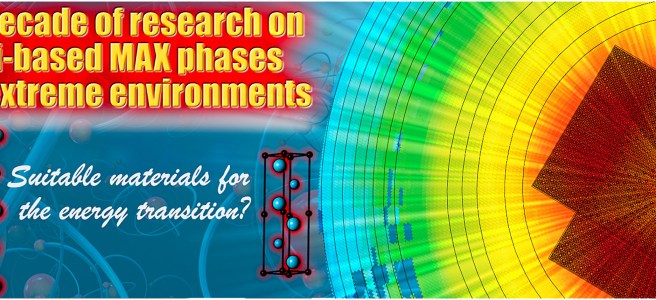
Can Ti-based MAX phases -- this new class of potential functional materials -- be applied in future nuclear reactors? We investigated the response of Ti-based MAX phases to both neutrons and heavy ions. The discoveries of this intense decade-long research has just been published at Materials Today Energy. Open access article access here: https://doi.org/10.1016/j.mtener.2022.101186