Our recent work entitled "Rethinking radiation effects in materials science using the plasma-focused ion beam" published in the September issue of the historically prestigious Journal of Materials Science (Springer) has been awarded the cover page of the November 2022 issue (volume 57, number 41). A very nice editorial has been written by Professor C. Barry … Continue reading Using the Plasma FIB as a revolutionary tool for studying radiation effects in solids: cover page award!
Tag: Nuclear
Nanocrystalline lightweight alloys for space exploration
We continue in our saga aiming at finding better radiation-resistant materials for applications in the extreme environment of the solar system. I am delighted to introduce you our new paper that was led by Patrick Willenshofer (another genius from Montanuniversitaet Leoben). In this paper, we introduce a revolutionary nanocrystalline crossover aluminium alloy that scored the … Continue reading Nanocrystalline lightweight alloys for space exploration
Rethinking Radiation Effects in Solids
With great pleasure I would like to share our most recent paper, which just got published at the Journal of Materials Science, edited by Professor C. Barry Carter. In this new article, we present an innovative methodology to rethink the way we investigate radiation effects in materials science: by using the Plasma Focused Ion Beam … Continue reading Rethinking Radiation Effects in Solids
Nuclear Materials Highlights – Issue #2
Dear Friends! We would like to wish you an excellent 2022 start with great accomplishments in life and research! This year starts a great promise with the commission of the James Webb space telescope, which holds the future of astronomy and astrophysics! With the beginning of the new year, we will resume the Nuclear Materials … Continue reading Nuclear Materials Highlights – Issue #2
Magnetic nanoislands: our interview to “Jornal da USP”
Our interview to Journal da USP is now online, in Portuguese: https://jornal.usp.br/ciencias/liga-metalica-esconde-material-magnetico-com-potencial-para-aprimorar-dispositivos-eletronicos/ A link with an English translation provided by Google is here: https://jornal-usp-br.translate.goog/ciencias/liga-metalica-esconde-material-magnetico-com-potencial-para-aprimorar-dispositivos-eletronicos/?_x_tr_sl=auto&_x_tr_tl=en&_x_tr_hl=en-US
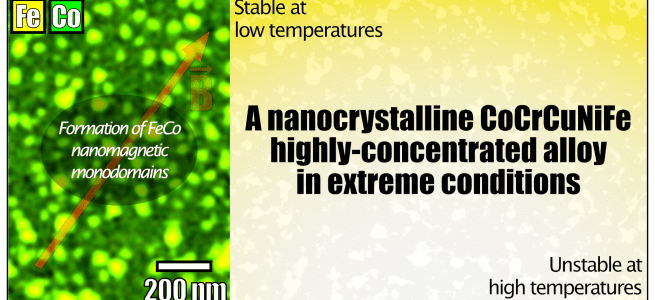
Discovery of FeCo nanomagnets under irradiation in a high-entropy alloy
A modified version of the well-known Cantor's alloy, the nanocrystalline CoCrCuFeNi high-entropy alloy was subjected to heavy-ion irradiation in situ within a TEM in our most recent study within the field of potential new nuclear materials. The stability of the alloy was investigated in a broad range of irradiation doses and temperature, revealing the nucleation … Continue reading Discovery of FeCo nanomagnets under irradiation in a high-entropy alloy
MATLAB now fully integrated with SRIM!
We have completed -- once and for all -- a full integration of MATLAB with the SRIM code. Now the MATLAB code features the possibility to calculate displacement-per-atoms (DPA) in a wide variety of conditions and using all existing DPA methodologies (R.E. Stoller with quick-damage and Y. Zhang with full cascades). Calculations are performed in … Continue reading MATLAB now fully integrated with SRIM!
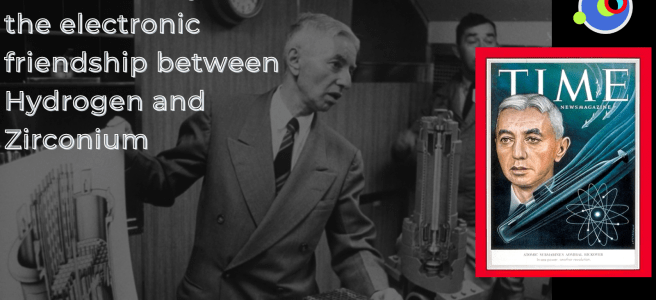
The interplay of H in degrading Zr and its alloys
In a recent talk, I address the problem of H in deteriorating severely the properties of the most important metal in nuclear industry, Zr, due to the formation of the Zr hydrides. A throughout good paper H effects in metals was recently written by Professor Milos Djukic, which I highly recommend reading. Abstract The decision … Continue reading The interplay of H in degrading Zr and its alloys
ACerS highlights Cr2AlC MAX Phases pathway to extreme environments
MAX radiation protection for next-generation nuclear power plants, by Jonathon Foreman, Ceramic Tech Today. "The radiation tolerance of MAX phases is of particular interest to researchers because it makes these materials ideal candidates for use in next-generation nuclear power technologies. Studies that exposed various MAX compositions to low and high doses of high-energy ions found … Continue reading ACerS highlights Cr2AlC MAX Phases pathway to extreme environments
Cr-based MAX phase as potential nuclear materials
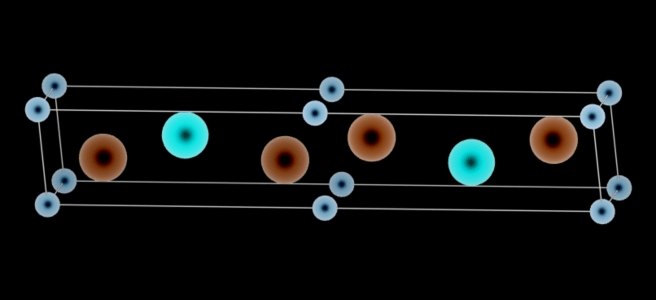
Ceramics are known to amorphise under energetic particle irradiation. We show Cr2AlC MAX phase -- even in its non-pure semi-crystalline form -- can resist to amorphisation when in its grain-size falls into the nanocrystalline regime (10-100 nm)! Free access at: https://doi.org/10.1126/sciadv.abf6771