An entire life dedicated to nuclear radiation physics and mentorship

Professor Kenya Moore de Almeida Dias da Cunha was a Brazilian nuclear physicist who dedicated her entire life to the study of actinide materials and in the academic education and scientific initiation of the next generation of research scientists. She was a lovely and passionate experimental scientist -- to the best definition of the term … Continue reading An entire life dedicated to nuclear radiation physics and mentorship
The influence of He bubble in strengthening of Copper

It is good to see that scientists are working hard to better evaluate the effect of He bubbles in metals and alloys! Sharing a very interesting new article showing unequivocally the influence of He bubbles in the strengthening behavior of Copper! By using shock loading, Lear et al. discovered that He bubbles totally collapse, leaving … Continue reading The influence of He bubble in strengthening of Copper

New H-based materials for use in micro-nuclear-reactors

We just got a preprint available in arXiv.org for the general audience: "Fabrication of bulk delta-phase Zirconium Hydride from Zircaloy-4 for use as moderators in microreactors" (arXiv:2305.02249v1) In this manuscript, we performed a complete electron-microscopy characterization of the delta-phase Zirconium Hydride (delta-ZrH) currently under manufacturing, research and development to be used as moderator materials in … Continue reading New H-based materials for use in micro-nuclear-reactors

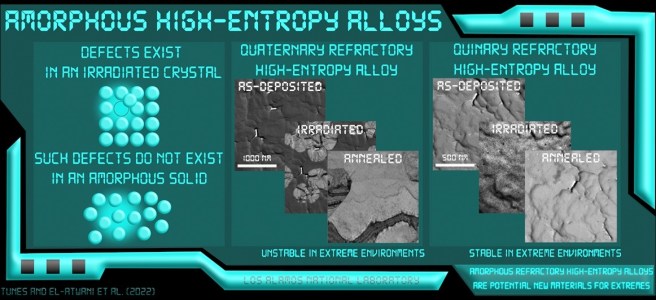
Amorphous and Refractory High Entropy Alloys

In this very interesting new field of research on refractory amorphous high entropy alloys (RAHEA), we present a case where two different RAHEAs have been synthesized and tested under extreme environments: the WTaCrV and WTaCrVHf. We discuss the parameters that may guide the design and application of these interesting alloys in future nuclear reactors and … Continue reading Amorphous and Refractory High Entropy Alloys

Novel high entropy ceramics for extreme environments

We investigate the radiation response of a hard refractory high entropy carbide (HEC): the (CrNbTaTiW)C. Comparison with the high entropy alloy (HEA) has shown the HEC outperforms the HEA under irradiation. Results suggest high-entropy ceramics can be alternative to HEAs in extreme environments. Available now at Acta Materialia (open access)! Do not forget to see … Continue reading Novel high entropy ceramics for extreme environments

Advancing the field of fine-grained aluminium alloys

In a new pre-print available at SSRN Electronic Journal, Samberger et al. introduce a new concept for fine-grained aluminium alloys. The authors shows a process of synthesis that resulted in a fine-grained aluminium crossover alloys intended to be applied in high-temperature forming processes. The use of EBSD unravels the active role of T-phase precipitates on … Continue reading Advancing the field of fine-grained aluminium alloys

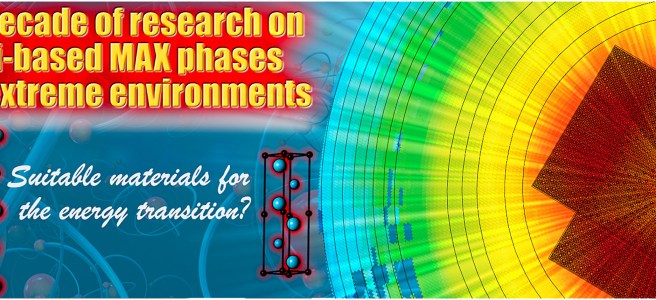
A decade probing the radiation response of Ti-based MAX phases

Can Ti-based MAX phases -- this new class of potential functional materials -- be applied in future nuclear reactors? We investigated the response of Ti-based MAX phases to both neutrons and heavy ions. The discoveries of this intense decade-long research has just been published at Materials Today Energy. Open access article access here: https://doi.org/10.1016/j.mtener.2022.101186

Nanocrystalline lightweight alloys for space exploration

We continue in our saga aiming at finding better radiation-resistant materials for applications in the extreme environment of the solar system. I am delighted to introduce you our new paper that was led by Patrick Willenshofer (another genius from Montanuniversitaet Leoben). In this paper, we introduce a revolutionary nanocrystalline crossover aluminium alloy that scored the … Continue reading Nanocrystalline lightweight alloys for space exploration