
In a recent talk, I address the problem of H in deteriorating severely the properties of the most important metal in nuclear industry, Zr, due to the formation of the Zr hydrides. A throughout good paper H effects in metals was recently written by Professor Milos Djukic, which I highly recommend reading.
Abstract
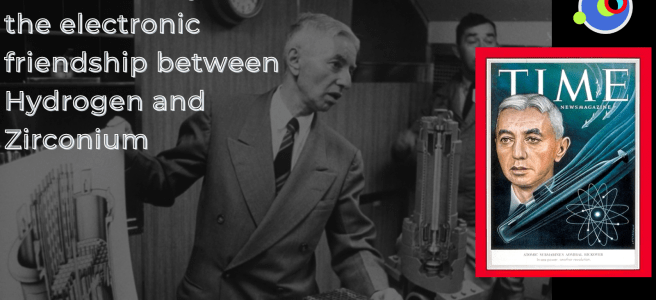
The decision on selecting Zr alloys as the nuclear fuel cladding material in the first generation of nuclear-powered reactors was made early in the 1950s by the US Navy under the leadership of Admiral Hyman G. Rickover working at the Oak Ridge National Laboratory. In the search for a material with high corrosion resistance at both moderate and high temperatures, suitable radiation tolerance and low cross-section for neutron absorption, Zr clearly outperformed its competitors, which were mainly stainless steel, Al, and Be. Despite the success reflected by more than 70 years of nuclear-powered fleet operation without any considerable accident, a significant mechanism of degradation of Zr alloys was discovered during the decision time: the interplay of H in deteriorating the high inherent ductility of the metal Zr via the formation of H-rich precipitates known as Zr hydrides. The metallurgical and physico-chemical aspects of the Zr alloying with H will be reviewed in this presentation along with the efforts towards characterizing Zr hydrides using conventional diffraction and electron-microscopy methods. Focus of the presentation will be given on recent works reporting on the phase stability of zirconium hydrides under temperature and irradiation and on the site-specific dependencies of H concentrations within zirconium hydrides.
I hope you enjoy!
The presentation can be downloaded here: https://www.researchgate.net/publication/352296663_A_brief_history_of_the_electronic_friendship_between_H_and_Zr

 Materials at Extremes