Rethinking copper metallurgy for the future of fusion reactors
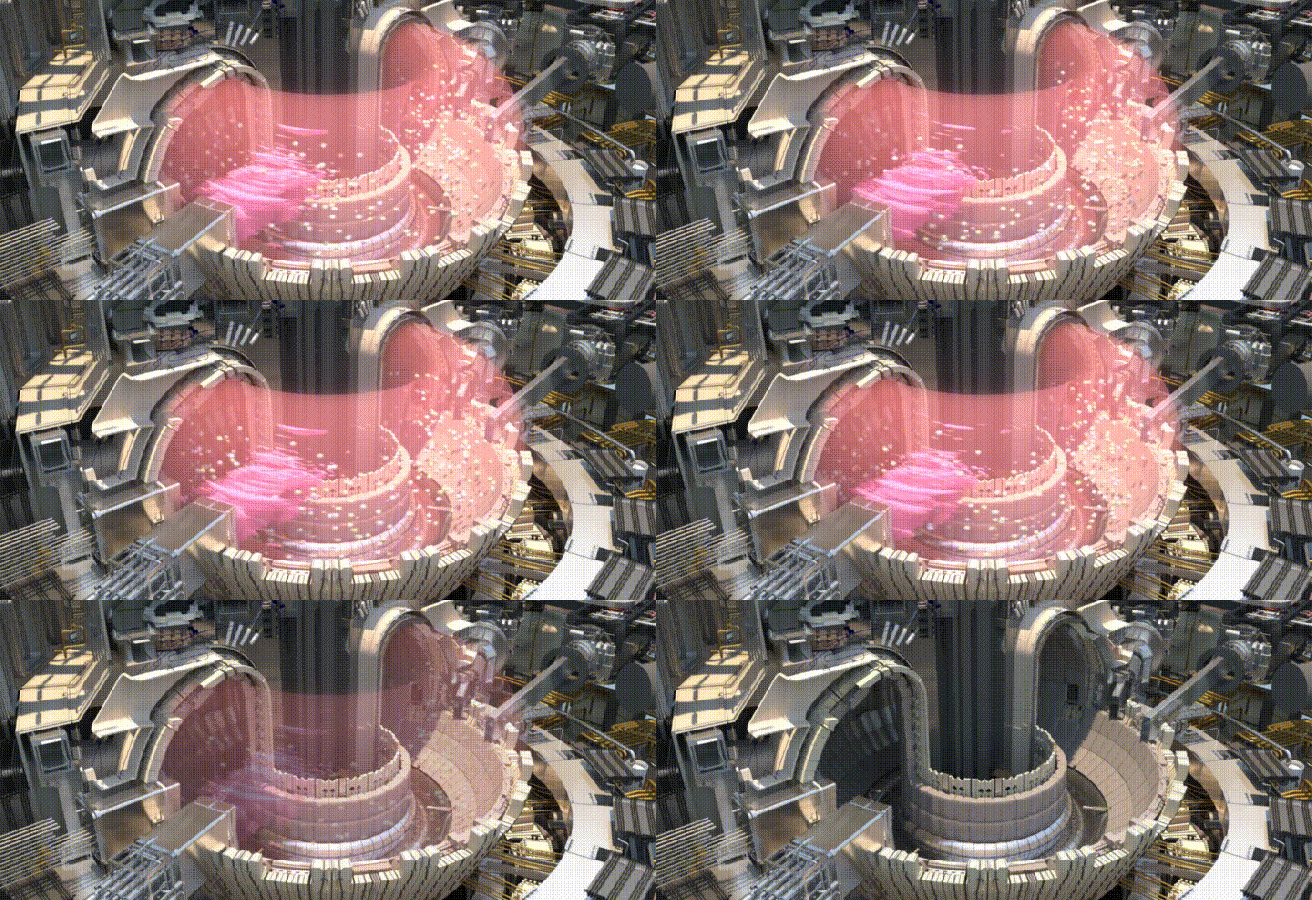
We are delighted to share a new preprint that takes on one of fusion energy's most stubborn materials problems: building a heat sink that can survive inside a reactor. Commercial fusion demands components that withstand intense neutron bombardment while extracting punishing heat loads for conversion to electricity, and CuCrZr — a copper alloy strengthened by … Continue reading Rethinking copper metallurgy for the future of fusion reactors

How much radiation damage can you do in seconds?

Qualifying materials for future fission and fusion reactors is painfully slow. Neutron irradiation is costly, time-consuming and leaves samples radioactive, while ion-beam alternatives require competitive proposals and scheduled beam time at oversubscribed accelerator facilities. In a new preprint, we ask whether an instrument already sitting in many microscopy labs — the plasma focused ion beam … Continue reading How much radiation damage can you do in seconds?

A snapshot of high-entropy alloy processing techniques and their effects on resulting mechanical properties

With great pleasure I am sharing with you our new review paper entitled "A snapshot of high-entropy alloy processing techniques and their effects on resulting mechanical properties" written by Mr. Christopher Matthews, a brilliant alumni student from the Los Alamos National Laboratory and the Dakota School of Mines, now a Master Student in Metallurgy at … Continue reading A snapshot of high-entropy alloy processing techniques and their effects on resulting mechanical properties

Leoben makes waves in fusion materials research

The [X-MAT] team at the Chair of Nonferrous Metallurgy, Montanuniversität Leoben, has drawn global attention with a groundbreaking study published in Advanced Science (DOI: 10.1002/advs.202417659). With more than 1k views and reads in the journal's first month after publication, our work challenges the prevailing high-entropy alloy (HEA) paradigm by proving that even simpler alloy systems can outperform their … Continue reading Leoben makes waves in fusion materials research

Energising the AI Era and Beyond with Nuclear Microreactors

Feature image credits: Westinghouse’s eVinci microreactor, a cross-section of which is shown here, is one of two microreactors that will be tested by the U.S. Department of Energy. Westinghouse Electric Company. The race to meet the soaring energy demands of AI technologies and data centres is driving innovation at an unprecedented pace. One of the … Continue reading Energising the AI Era and Beyond with Nuclear Microreactors

Revolutionary Findings in Nonferrous Metallurgy for Fusion Technology

03/20/2025 The [X-MAT] research team from the Chair of Nonferrous Metallurgy, in collaboration with international partners, has made a significant breakthrough in the development of radiation-resistant materials for nuclear fusion reactors. Their latest study, published in Advanced Science (DOI: 10.1002/advs.202417659), challenges conventional high-entropy alloy (HEA) concept by demonstrating that reduced chemical complexity can still achieve … Continue reading Revolutionary Findings in Nonferrous Metallurgy for Fusion Technology

Who is leading the critical technology race?

For anyone interested in global technological and scientific advancements, ASPI’s Tech Tracker offers a fascinating deep dive into critical and emerging industries. One of the most striking insights from the platform is China’s clear dominance in nuclear energy. With extensive research, rapid reactor deployments, and significant government support, China has positioned itself as a world … Continue reading Who is leading the critical technology race?

Probing the High-Entropy Concept Through the Irradiation Response of Near-Equimolar (CrNbTaTiW)C Ceramic Coatings

As researchers and enthusiasts of materials engineered for extreme environments, we are thrilled to share an exciting new advancement in the field of high-entropy ceramics (HECs). Our journey into the world of radiation-resistant materials has led us to examine the latest findings from a novel study: Probing the High-Entropy Concept Through the Irradiation Response of … Continue reading Probing the High-Entropy Concept Through the Irradiation Response of Near-Equimolar (CrNbTaTiW)C Ceramic Coatings

Radiation shielding for nuclear-fission powered human-based Mars missions

As multinational space programs progress towards establishing permanent human settlements beyond Earth, radiation shielding and damage continue to pose significant challenges. A fascinating recent paper discussing radiation shielding in the context of future nuclear-fission-powered Mars missions has been published in Nuclear Science and Technology Open Research. Bendoyro AC, Thomas LD, Cassibry J and Emrich W. … Continue reading Radiation shielding for nuclear-fission powered human-based Mars missions

Microstructural Characterization of Nanostructured Aluminium Crossover Alloys under Thermal Loading

We are happy to share the publication of our latest paper titled “Comparative analysis of experimental techniques for microstructural characterization of novel nanostructured aluminium alloys” on Materials Characterization. In this study, we delve into the intricacies of using various experimental techniques to analyze the microstructures of an ultrafine-grained AlMgZnCuAg crossover alloy under themal loading. Through … Continue reading Microstructural Characterization of Nanostructured Aluminium Crossover Alloys under Thermal Loading