
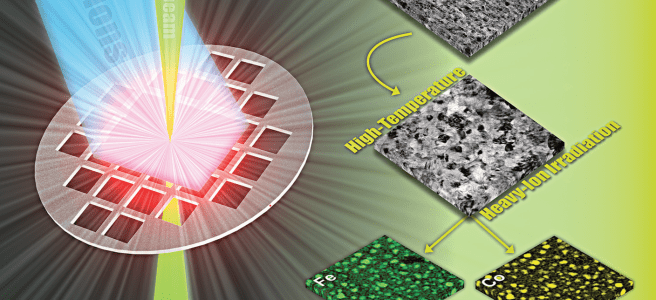
Despite their diminutive size, iron and cobalt nanoislands have strong magnetism, which can increase storage and data transfer capacity.
Researchers have evaluated the radiation resistance of highly concentrated metal alloys for use in nuclear reactors and have identified materials with exceptional magnetic properties. Called magnetic nanoislands, these materials contain iron and cobalt and, despite being at the nanometric scale, that is, having an extremely small size, they have strong ferromagnetism. The magnetic properties of nanoislands indicate a potential future application in electronic data storage and transfer devices, increasing their speed and performance. The international study was carried out with the participation of the Polytechnic School (Poli) of USP, and the discovery is reported in an article published in the journal Nanoscale, of the Royal Society of Chemistry., in the United Kingdom.
“A metal alloy is basically a metallic material made from the mixture of two or more elements, which gives it unique properties, such as corrosion resistance. In recent years, highly concentrated metal alloys have had a high impact on the international scientific communities of metallurgy and materials science”, says physicist Matheus Tunes, one of the authors of the work. “These alloys can be produced using conventional metallurgy methods, using furnaces, and also through physical techniques of deposition on thin films for laboratory scale tests. While in conventional alloys, such as stainless steel, there is a base metal to which small amounts of other elements are added, in highly concentrated alloys, the concentrations of the elements are practically equal.”

To produce the alloy, a method of physical deposition of thin films was used for laboratory scale tests. “It was produced with five elements – cobalt, chromium, copper, iron and nickel – in similar amounts. After the synthesis of the alloy, it was found that the atoms of each element occupied random positions, forming a disordered solid solution”, reports Tunes. “This alloy did not show good resistance to irradiation, questioning the hypothesis that it has high stability. But surprisingly, under irradiation and annealing at moderate temperatures, iron and cobalt came out of solid solution, to form nanometric precipitates with a cubic structure.”
Magnetism
Then, the iron and cobalt precipitates were subjected to a transmission microscopy technique called differential phase contrast. “The technique, which is relatively new, is applied by means of an electron microscope, which emits a beam of electrons on the analyzed material”, says the physicist. “The study found that the precipitates are able to polarize the electron beam of the microscope in a specific direction, qualitatively evidencing the presence of strong ferromagnetism. As the magnetism of these precipitates is manifested at the nanometer scale, they were called magnetic nanoislands.”

Although the alloy is not stable, ruling it out for use in reactors, research demonstrates that it is possible to synthesize magnetic nanoislands of iron and cobalt from a highly concentrated alloy at relatively low temperatures of around 500 degrees Celsius (ºC). “We also found that, once formed, the magnetic nanoislands remain stable at high and low temperatures, indicating that the equilibrium state of the alloy is due to their presence”, says Tunes. “In parallel to our study, there are two recent papers published by researchers from Germany that quantitatively prove the unique magnetic properties of nanoislands, and in both works they are formed from a highly concentrated alloy.”

“As this is a new area of research, the theoretical basis is obviously not yet fully established, although the high number of experimental publications proves that these alloys have interesting properties that will inevitably result in the discovery of new functional materials”, concludes Tunes.
The research was led by the Los Alamos National Laboratory (United States), where the researcher is currently located, with the participation of the Poly Materials Thermodynamics research group, led by Professor Cláudio Geraldo Schön. The Oak Ridge National Laboratory (United States), the Universities of Tennessee (United States), Huddersfield (United Kingdom) and Leoben (Austria) also took part in the work.
More information: e-mail m.a.tunes@physics.org, with Matheus Tunes, and schoen@usp.br, with Professor Cláudio Geraldo Schon

 Materials at Extremes