

Featured image credits: Galileo orbiter spacecraft, NASA/JPL.
Nuclear engineering, a remarkable creation of the human mind, has brought essential technological advancements since the dawn of the modern era. Innovations like nuclear reactors, complex thermohydraulic machines that fully harness the power of the atom, provide humanity with electricity — direct benefits born from decades of research and development in nuclear physics and materials science. From the dawn of the atomic age to the present times, nuclear engineering is evolving towards the miniaturisation of nuclear power reactors.
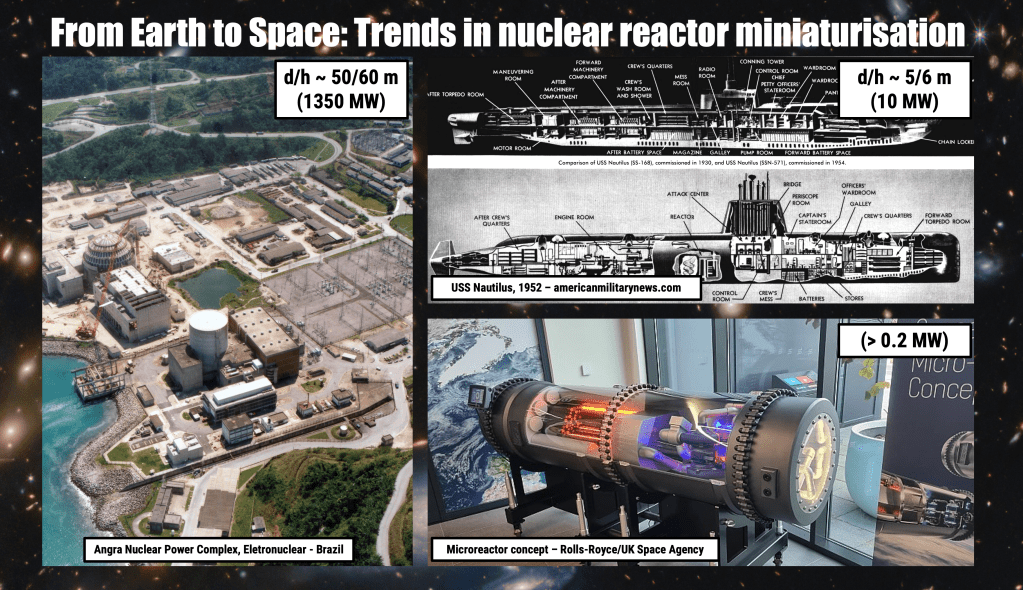
The development of microreactor technology offers an efficient solution for portable electricity generation, supporting both human space exploration within our solar system and also powering remote areas on Earth. Yet, the miniaturization of nuclear reactors introduces new challenges for materials science, particularly in controlling nuclear reactions through thermalization of highly energetic neutrons. In microreactors, neutron moderation occurs in compact geometries, necessitating moderator materials with high moderating power per unit volume. This challenge is being addressed through the development of transition metal hydrides, known for their strong nuclear moderation capabilities, but research on their response to irradiation remains limited, especially about phase stability, hydrogen retention within the hydride lattice, and the effects of irradiation temperature and dose.
The Paper
M.A. Tunes et al. Challenges in developing materials for microreactors: A case-study of yttrium dihydride in extreme conditions, Acta Materialia, Volume 280, 2024, 120333, ISSN 1359-6454, https://doi.org/10.1016/j.actamat.2024.120333


The Acknowledgments
I would like to personally thank the Laboratory Direct Research and Development for supporting my research at the Los Alamos National Laboratory through the directors’ fellowship grant 20200689PRD2 “Highly Ordered Refractory Intermetallics: The ZIA-Phases Project”.
I also would like to thank Dr. Saryu J. Fensin – team leader of the quasi-static and dynamic behavior of materials team in the LANL’s Materials Physics and Applications Division at Center for Integrated Nanotechnologies (MPA-CINT) – for providing mentorship, funding and scientific support at the end period of my postdoctoral research fellowship at LANL.
In this new study just published in the prestigious journal Acta Materialia, we present a detailed investigation into the response of yttrium dihydride (YH2) to heavy ion irradiation. Our experiments show that YH2 remains stable up to an irradiation dose of 2 displacements per atom (dpa) and below 800°C, identified as a critical temperature for YH2. We observed nucleation and growth of voids as a function of irradiation temperature, which emerged as the predominant form of radiation damage, distinct from pre-existing defects in pristine YH2 samples. Below the critical temperature, no phase transformation, degassing, or amorphization was detected. Experimental results, integrated with density functional theory calculations, enabled us to propose new strategies for enhancing the performance of metal hydrides in extreme environments, significnatly contributing for the emerging technological leap posed by microreactor technology.

Credits: x-mat.unileoben.ac.at
Through the emerging development of microreactor technology, the yttrium dihydride is a particular case in the history of science as it is the prominent candidate material that may allow very soon, a definitive human settlement on the Moon within scope of the NASA’s Artemis mission.
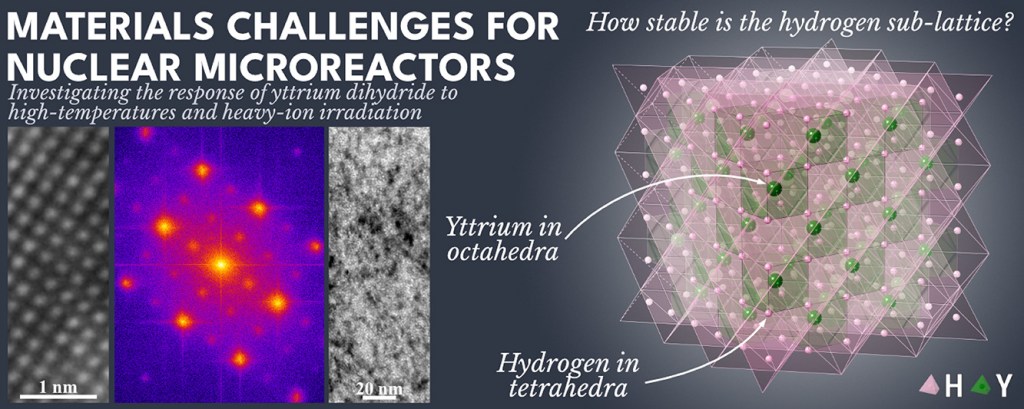
Manufacturing hydrides in a pure form is also a major challenge for metallurgy. Dr. Aditya Shivprasad, currently working at the Electric Power Research Institute (EPRI) is the mastermind in the production of these YH2 in pure form (check his previous publications here, here, and here). At the [X-MAT] we are also pursing scientific research in the manufacturing of transistion metal hydrides in different forms, geometries, and precursor materials with the major objective to increase the stability of the hydrogen sublattice in extreme environments.
With metallurgy, “to the infinity… AND BEYOND”!

 Materials at Extremes