Professor Milos Djukic Brings Hydrogen Masterclass to Leoben

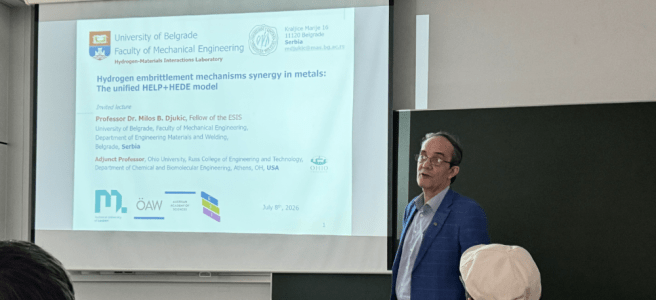
This week we had the great pleasure of welcoming Professor Milos B. Djukic (University of Belgrade, Faculty of Mechanical Engineering) to Leoben — a world-class authority on hydrogen embrittlement and one of the most influential voices in the field today. Professors Djukic and Keckes at ESI. Professor Djukic visited at the invitation of Professor Jozef … Continue reading Professor Milos Djukic Brings Hydrogen Masterclass to Leoben

A new way to “see” inside aluminium alloys

What if a single microscope image could simultaneously show nanoclusters, dislocations, grain boundaries, and corrosion pores – all in under a minute? We have found a way to do exactly that and we described recently in a paper published it in Small Methods! The method, called differential phase contrast (DPC), is not new to electron … Continue reading A new way to “see” inside aluminium alloys

The nanoscale secrets of melting in eutectic systems

Eutectic systems have shaped mankind for millennia — bronze, solder, casting alloys — and yet, for all their industrial pedigree, the nanoscale mechanics of how they actually melt has remained stubbornly out of reach. Experimental resolution simply could not keep up with the physics. A new preprint from our group closes that gap, using in … Continue reading The nanoscale secrets of melting in eutectic systems

Battery waste is worth billions!

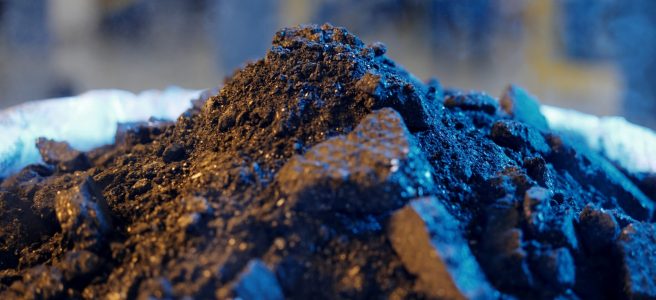
As the world accelerates its transition to electric vehicles and renewable energy, the pressure to recycle lithium-ion batteries efficiently has never been greater. At the heart of most recycling processes sits a fine black powder called black mass — a mixture of cathode and anode materials, binder residues, and metallic fragments recovered from spent batteries. … Continue reading Battery waste is worth billions!

When electron microscopes think for themselves: has China just changed science forever?

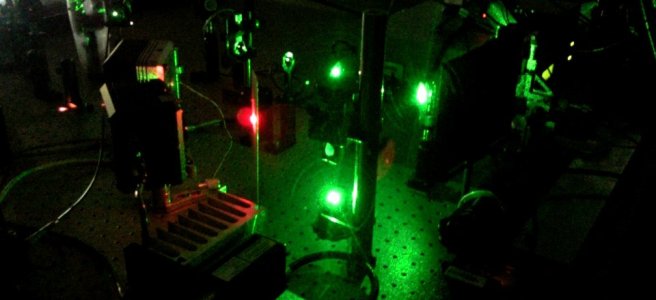
A Chinese research team at the Dalian Institute of Chemical Physics has announced what could prove to be a remarkable leap forward in scientific instrumentation: an intelligent transmission electron microscope (TEM) capable of fully autonomous operation. The device, named Yuanyan-1, reportedly harnesses artificial intelligence to overcome longstanding limitations of conventional TEMs, which have depended on … Continue reading When electron microscopes think for themselves: has China just changed science forever?

An Humanist Perspective in 2026

Throughout history, humanity has poured its greatest minds, resources, and energy into two competing endeavours — the pursuit of knowledge, and the pursuit of conflict. The choice between them could not be more consequential. War destroys. It consumes lives, erases cultures, and sets civilisations back by generations. Whatever political aims it serves, its legacy is … Continue reading An Humanist Perspective in 2026

Atom-by-atom materials shaping future technology

What will the materials powering tomorrow's clean energy systems, quantum computers, and deep-space missions actually be made of — and how do we design them? We are thrilled to share our latest featured article in The European magazine, where we explore how cutting-edge research is engineering matter at the atomic scale. From the nanolaminated MAX … Continue reading Atom-by-atom materials shaping future technology

“An ode to a nuclear genious who met the microstructure”

A beautiful poem written by Anna-Carina Seitlinger to her beloved boyfriend Christoph Frühwirth on the 19th December 2025' [X-MAT] Secret Santa and end of yearly dinner meeting! I am reproducing the poem in its full format as released by both Anna and Christoph! Once king of fission, neutron and core,Criticality fears him – equations adore.Reactors … Continue reading “An ode to a nuclear genious who met the microstructure”

Stop Harassement in Science!

The recent Nature editorial highlights the persistent and often underestimated problem of bullying and harassment in academia. It stresses that scientific excellence cannot be separated from the integrity of the research environment: organisations that ignore harmful behaviour ultimately undermine both their people and the quality of their work. The article calls for transparent procedures, responsible … Continue reading Stop Harassement in Science!