

In early 2014, while conducting a literature review for my Master’s thesis at the University of São Paulo, I visited the library of the Institute of Physics (IFUSP), my alma mater, to search for papers dating back to the origins of nuclear materials research. At the time, I was a curious 22-year-old, freshly graduated physicist.
The IFUSP library holds physical copies of the Philosophical Magazine journal, and there I found seminal papers written by scientists from the United Kingdom Atomic Energy Authority (UKAEA) on the subject. Transmission Electron Microscopy (TEM) was entirely unfamiliar to me then. My main interest was in understanding how scientists quantify radiation damage in materials. After reading two seminal articles by Professor Niels Bohr, who first theoretically considered radiation damage processes caused by ions striking matter [1,2], I became eager to understand if it was possible to “see” radiation damage in metals.
Among numerous papers by UKAEA researchers, such as Hirsch, Barnes, Pashley, Whelan, Silcox, and others, one particularly caught my attention. It was written by David J. Mazey and reported on the formation of dislocation loops in aluminium after bombardment with alpha particles (He nuclei) [3]. I was fascinated by the opportunity to visually witness the effects of radiation damage on materials. David J. Mazey—who sadly passed away recently at the age of 95—was a pioneer in using TEM to detect radiation damage and defects in the microstructure of aluminium. This area of research has since captivated me, and it now occupies almost all of my time. I can say that it was Mazey’s papers on irradiated aluminium that motivated and inspired me to pursue a PhD in nuclear materials with Professor Stephen E. Donnelly.
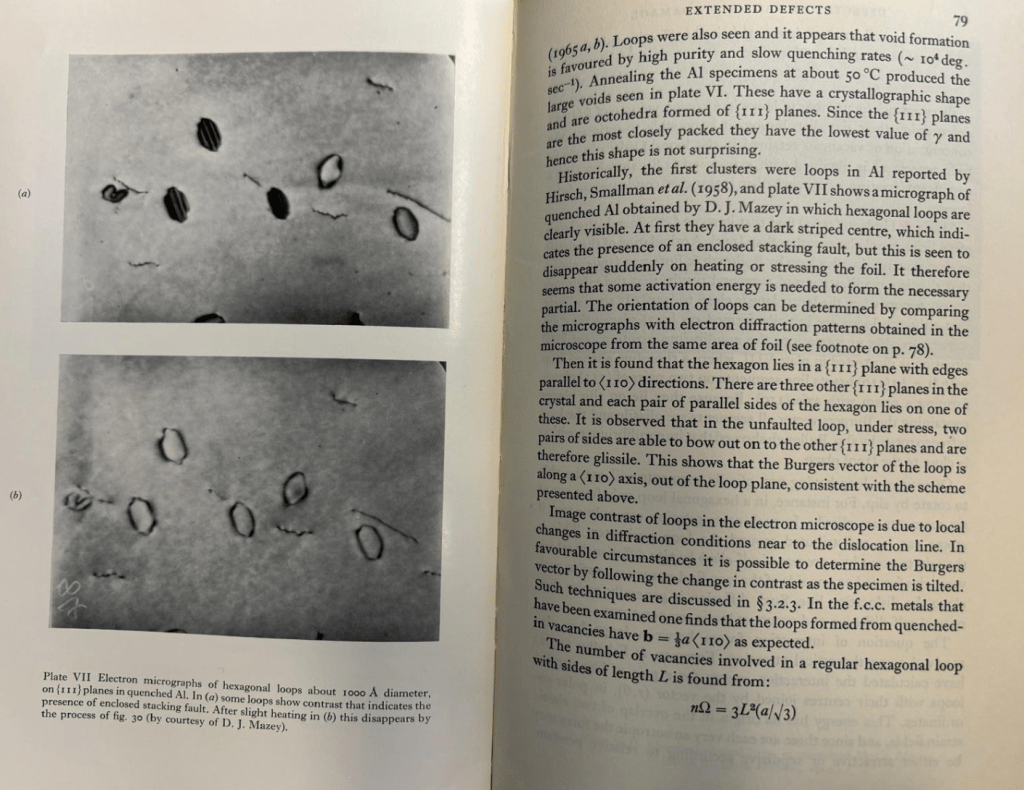
As in life, science follows cycles. It is always deeply saddening when a scientist whose work I admire passes away. Not only do we lose an extraordinary expert, but also a friend, colleague, and partner, leaving a void for those who remain. After all, scientists are human too. Mazey had a prolific scientific career, and fortunately, he published his research, providing invaluable documentation for future generations of scientists like myself.
Unfortunately, I never had the chance to meet Mazey. The only member of Professor Hirsch’s UKAEA/Oxford group I have had the pleasure of meeting in person, at Los Alamos National Laboratory, is Professor C. Barry Carter (https://en.wikipedia.org/wiki/C._Barry_Carter), another remarkable individual. Professor Carter knows the history of the developments on nuclear materials within the group of Professor Hirsch. We need to document this at some point.
The nuclear materials community is an extraordinary one. We are multi and transdisciplinary. The work we do to understand the effects of radiation on materials is not only crucial for nuclear reactor technology but also for space exploration, energy production, and the broader fields of materials science and metallurgy. Many advancements in metallurgy were driven by the nuclear community. Sadly, I feel we do not always give proper attention to documenting our history. Believe or not I even got some snobbish comments in a recent grant application by being a member and having expertise in nuclear materials… I don’t see younger generations showing much interest in this historiography, which is very unfortunate. The history of our community is absolutely fascinating, and it deserves better treatment and respect. I wish I could go back in time to witness the remarkable scientific developments at UKAEA Harwell during the 1950s and 1960s.
Below is a text written by Professor Dr. John Evans [4,5], a long-standing friend, neighbour, and collaborator of David J. Mazey at UKAEA.
David John Mazey, 1929 – 2024
By John Evans, BSc, PhD, DSc
https://www.researchgate.net/profile/J-Evans-2
It is sad to report the recent death of David Mazey at the age of 95. Although he had no formal education, his work on a wide ranging number of areas in Materials Science earned him a PhD, and later the higher DSc degree.
After growing up in the Berkshire / Oxfordshire countryside, he joined the U.K. Royal Air Force at the age of 18, just after WW2, and worked on various aspects of aircraft maintenance. This evidently sparked his ambition to start a career and in 1955 he started his 40 years at the Atomic Energy Research Laboratory, Harwell, initially as a Scientific Assistant, at the same time studying in evening classes. His enthusiasm and interest in everything was clearly evident and he quickly became a co-author on the first of over 100 papers. These papers covered over a wide range of topics from some of the first work on the behaviour of helium in metals (initially to simulate the behaviour of xenon and krypton on nuclear fuels but later related to fusion reactor work) through to the simulation of radiation damage induced void formation in fast reactor steels. En route, as shown on his ResearchGate page, he published some of the earliest work on both bubble lattices and solid krypton bubbles in metals, and was frequently consulted on fusion reactor materials.
As a colleague and neighbour, I knew him well. He was always convivial company with a wide array of interests outside science. Photography, genealogy, travel, local history – all these kept him busy during retirement. He was liked and respected by all.

References:
[1] Bohr, Niels. “II. On the theory of the decrease of velocity of moving electrified particles on passing through matter.” The London, Edinburgh, and Dublin Philosophical Magazine and Journal of Science 25.145 (1913): 10-31. https://doi.org/10.1080/14786440108634305
[2] Bohr, Niels. “LX. On the decrease of velocity of swiftly moving electrified particles in passing through matter.” The London, Edinburgh, and Dublin Philosophical Magazine and Journal of Science 30.178 (1915): 581-612. https://doi.org/10.1080/14786441008635432
[3] Mazey, D. J., R. S. Barnes, and A. Howie. “On interstitial dislocation loops in aluminium bombarded with alpha-particles.” Philosophical Magazine 7.83 (1962): 1861-1870. https://doi.org/10.1080/14786436208213851
[4] Evans, J. H. “Observations of a regular void array in high purity molybdenum irradiated with 2 MeV nitrogen ions.” Nature 229.5284 (1971): 403-404. https://doi.org/10.1038/229403a0
[5] Evans, J. H., and D. J. Mazey. “Evidence for solid krypton bubbles in copper, nickel and gold at 293K.” Journal of Physics F: Metal Physics 15.1 (1985): L1. https://iopscience.iop.org/article/10.1088/0305-4608/15/1/001/meta

 Materials at Extremes