
I am an immigrant scientist living in Austria, a country I deeply love and serve with passion and commitment. Having experienced life as an immigrant in multiple countries, I understand that immigration is often a necessity (it was for myself), driven by the pursuit of peace, stability, and opportunity.
While ideally, I think no one should leave their home country and their beloved family and friends, immigrants demonstrate immense bravery and resilience, leaving everything behind to build a new life in foreign lands. From my father and mom sides, both families were immigrants from Italy/Portugal and Germany to Brazil, very brave people just trying to live their lives through stupid and unnecessary wars. I believe it is very unfair to blame immigrants for a false perception of failure and decadence of our society: a perception which is highly biased from common sense, non-factual information, and biased social media.
I will start in this blog, a new series of posts from histories I will be collecting from reading. The “immigrants that changed the world”. The purpose is just to show that many of the great discoveries we have had in science were made possible by immigration!
Throughout history, immigration has been a catalyst for progress, as individuals from diverse backgrounds contribute their talents to new environments. The scientific community has especially benefited from the contributions of immigrant scientists, whose groundbreaking work has shaped our understanding of the world.
Here, we highlight three exceptional scientists who emigrated to the United States and whose contributions remind us of the importance of embracing global talent.
1. Albert Einstein (1879-1955)
Field: Physics
Origin: Germany
Destination: United States
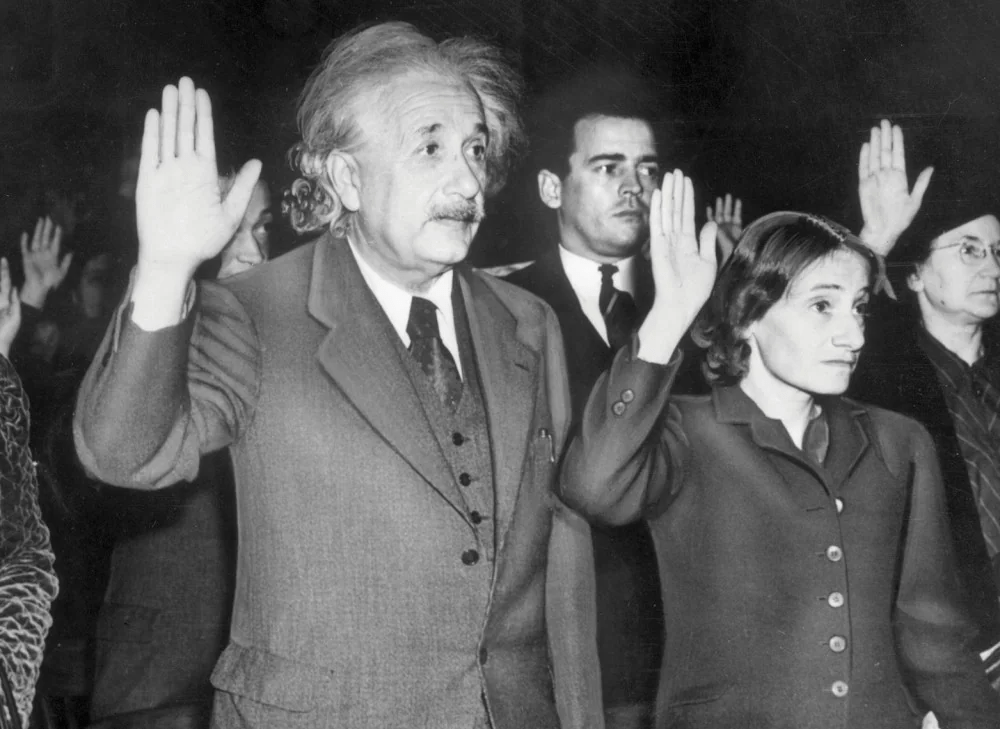
Albert Einstein and his daughter became citizens of the United States of America
Albert Einstein, perhaps the most famous scientist of all time, revolutionised physics with his theories of relativity, which reshaped our understanding of time, space, and energy. Born in Germany, Einstein fled to the United States in 1933 to escape the rise of the Nazi regime. Settling at the Institute for Advanced Study in Princeton, he became an outspoken advocate for peace and civil rights while continuing his scientific work. His immigration underscores how welcoming refugees can foster innovation that benefits humanity on a global scale.
2. Rita Levi-Montalcini (1909-2012)

Field: Neurobiology
Origin: Italy
Destination: United States
Prof. Levi-Montalcini in her TEM laboratory.
Rita Levi-Montalcini, a trailblazing neurobiologist, fled Italy during Mussolini’s regime. She eventually emigrated to the United States, where her groundbreaking research on nerve growth factors earned her the Nobel Prize in Physiology or Medicine in 1986. Levi-Montalcini’s journey highlights the profound contributions of immigrant scientists to medical and biological advancements.
3. Selman Waksman (1888-1973)

Field: Biochemistry
Origin: Russian Empire (modern-day Ukraine)
Destination: United States
Selman Waksman emigrated to the United States in 1910, where he pursued a career in biochemistry and microbiology. His pioneering research led to the discovery of streptomycin, the first effective antibiotic against tuberculosis, for which he won the Nobel Prize in Physiology or Medicine in 1952. Waksman’s story highlights how immigrants can contribute to life-saving advancements that benefit humanity on a global scale.
The Broader Impact of Immigration on Science
These stories are not just individual successes; they are reflections of a broader truth: immigration enriches societies, accelerates innovation, and builds bridges across cultures. When countries welcome immigrants, they gain access to a wealth of perspectives, skills, and ideas that drive progress.
As debates about immigration policies continue worldwide, it is worth remembering that the free exchange of talent across borders has been a cornerstone of human advancement. The next great breakthrough could very well come from someone seeking a new home and opportunity.
Let us celebrate and support the diversity that fuels innovation and progress in science and beyond!
Mattzi

 Materials at Extremes
Dear Matt, you have clearly outlined your mission with these three examples: You are on your way to the Nobel Prize. Good luck! Peter
LikeLiked by 1 person
Thank you Professor Peter. Rather than winning prizes, I just want to be useful and do fruitful things for the community! Mattzi
LikeLike