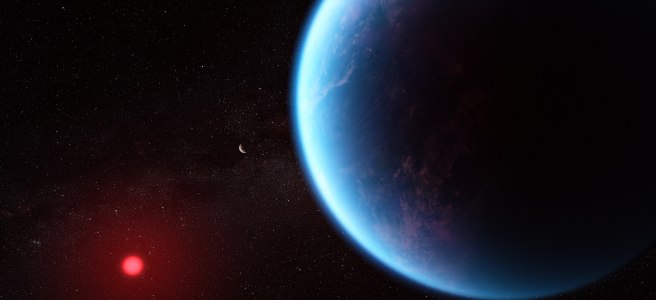
The discovery of hycean worlds – planets with global oceans and hydrogen-rich atmospheres – has reshaped our hunt for habitable environments beyond the solar system. One such world, K2-18 b, has now taken centre stage. Using the powerful James Webb Space Telescope (JWST), scientists recently analysed its atmosphere and confirmed the presence of carbon-bearing molecules like methane (CH₄) and carbon dioxide (CO₂), consistent with the expected chemistry of a hycean world. Even more intriguing was a possible detection of dimethyl sulfide (DMS) – a compound on Earth produced almost exclusively by marine life. While that first clue was faint, a new study using JWST’s mid-infrared spectrometer has added fresh support to this extraordinary possibility.
I wonder if the aliens exist in this world, how do they cope with hydrogen embrittlement in a hydrogen-gas-rich atmosphere!? A good question for Professor Milos Djukic!
Featured image credits: Illustration: NASA, ESA, CSA, Joseph Olmsted (STScI) Science: Nikku Madhusudhan (IoA) – https://webbtelescope.org/contents/media/images/2023/139/01H9R88HG8YXRMARWZ5B1YDT27
👉 Read the full study here:
Nikku Madhusudhan et al New Constraints on DMS and DMDS in the Atmosphere of K2-18 b from JWST MIRI, 2025 The Astrophysical Journal Letters 983 L40

 Materials at Extremes
Excelente blog.
Saludos desde España 🌷
LikeLiked by 1 person
Gracias ! Saludos desde Austria !
LikeLiked by 1 person
Espero que nos leamos 🌷
LikeLike