
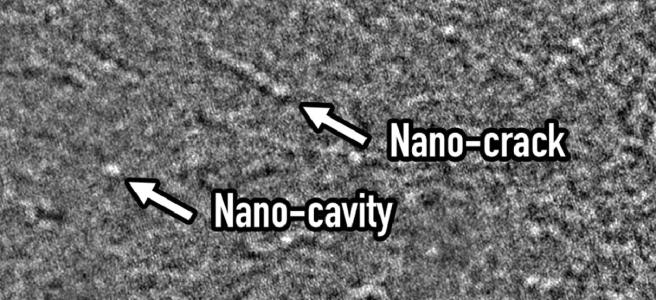
Hydrogen is often celebrated as the clean fuel of the future, but its relationship with metals is far more complicated than it might seem. When hydrogen atoms enter a metal, they can silently weaken it from the inside — a phenomenon known as hydrogen embrittlement — and despite being recognised for over 150 years, the earliest stages of this process have remained frustratingly difficult to observe directly. A new study published by our team – [X-MAT] – in Scripta Materialia has changed that.
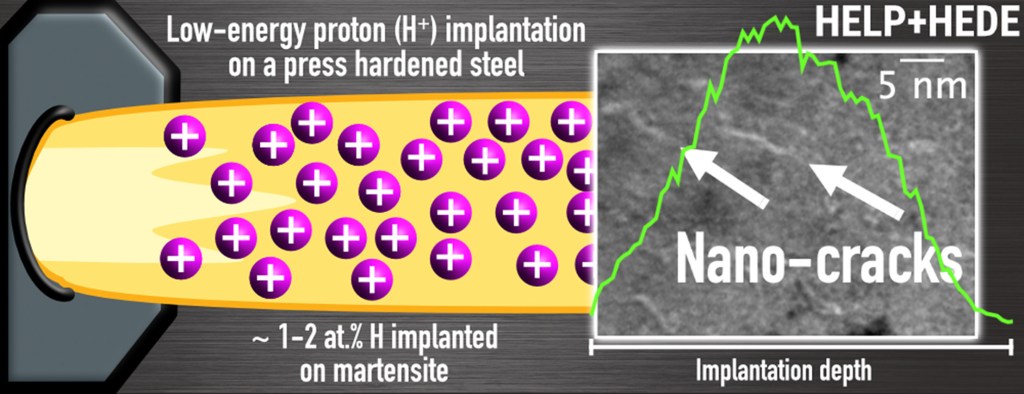
By firing low-energy protons into a martensitic steel — the kind used in automotive components — we were able to introduce hydrogen in a precise, controlled way and then image what happens at the nanoscale using transmission electron microscopy.
What we found is remarkable: the hydrogen did not simply diffuse through the steel uniformly. Instead, it interacted with tiny imperfections already present in the material — dislocations and vacancies left over from the steel’s own formation — to nucleate clusters of nano-sized cavities, each just over a nanometre across, arranged in striking one-dimensional rows. These cavities then grew and merged, ultimately forming nano-cracks within the steel’s microstructure.
This is the first time this cascade of events has been directly imaged in high-strength steels, offering a genuine window into how hydrogen embrittlement begins. As hydrogen plays an ever-greater role in our energy systems — from electrolysers to pipelines — understanding exactly how and why it damages the materials around it has never been more important. The results back the idea that hydrogen embrittlement is a two-act process: first softening the microstructure through enhanced local plasticity, then driving catastrophic atomic decohesion: Prof. Milos Djukic’s synnergistic HELP+HEDE conception!
Read it now (Open Acess): D.F.L. Borges, R.O. Silva, I.S.F. Carneiro, N.W.S. Morais, R.L. Sommer, N.R. Checca Huaman, P.J. Uggowitzer, E. Kozeschnik, M.B. Djukic, P.F.P. Fichtner, C.G. Schön, M.A. Tunes, “Low-energy proton implantation reveals the incipience of hydrogen embrittlement in a martensitic steel,” Scripta Materialia 277 (2026) 117238. https://doi.org/10.1016/j.scriptamat.2026.117238

 Materials at Extremes