

The sustainability debate in materials science sometimes asks the wrong questions.
How do we recycle more aluminium & steel? These are legitimate — but they treat recyclability/sustainability as an afterthought, forcing materials never designed for circularity back into something useful at considerable cost and energy penalty: facts that Europe, specially, cannot anymore afford.
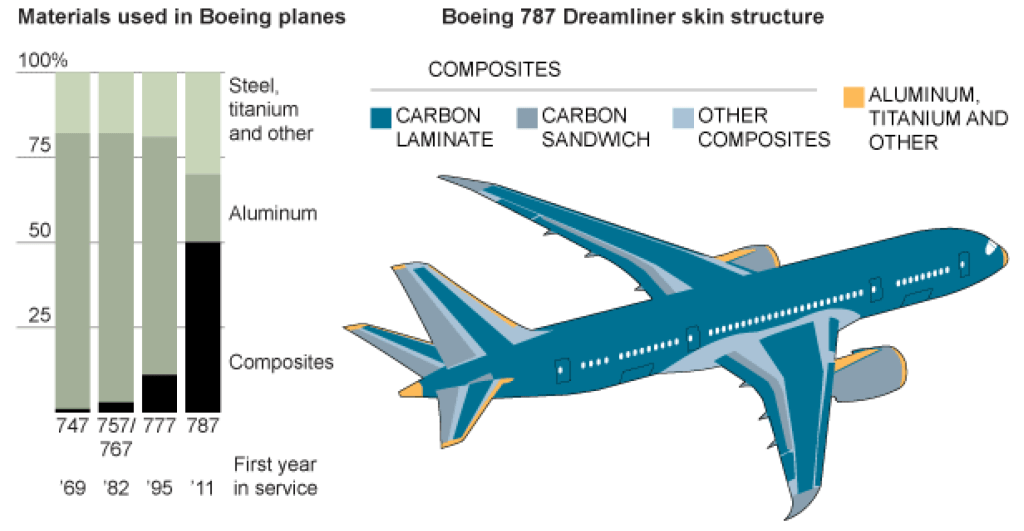
The most transformative step will not be better recycling processes for existing materials. It will be new material systems in which circularity is intrinsic — not added on.
The aerospace industry’s shift from aluminium to multi-material architectures has delivered real efficiency gains and it can be served as a best-example for future practices and trend research in metallurgy & materials science. The next shift should be just as deliberate — building sustainability in from first principles, not bolting it on afterwards.
The aerospace example will not remain an isolated case.
Across metallurgy, metalworking, and materials manufacturing — from structural steels to electronic substrates, from casting alloys to advanced coatings — the entire industrial ecosystem will face the same reckoning. Climate targets are not aspirational backdrops: they are fast becoming binding constraints that no material specification sheet can ignore.
The industries that will lead the future are those that invest now in deep, fundamental scientific research: not incremental improvements to what already exists, but the patient, science-driven pursuit of new materials that were never possible before.
That is a different kind of ambition from optimising a production line or tweaking an alloy composition. It demands a closer relationship between academia, industry, and policy — and a willingness to accept that the most important material of the next decade may not yet have a name!
References:
[1] Krzyzak, A.; Kosicka, E.; Borowiec, M.; Szczepaniak, R. Selected Tribological Properties and Vibrations in the Base Resonance Zone of the Polymer Composite Used in the Aviation Industry. Materials 2020, 13, 1364. https://doi.org/10.3390/ma13061364

 Materials at Extremes