
We are excited to share findings from our latest research on the potential use of MAX phases in nuclear reactors. MAX phases, known for their hexagonal-compact nanolayered crystal structure, high machinability, and chemical inertness, have long been considered promising materials for nuclear applications. However, our new paper sheds light on crucial aspects that must be … Continue reading Exploring the Stability of Ti-based MAX Phases in Extreme Nuclear Environments
Category: Nuclear Materials
Advancing microreactor materials technology: Next stop, the Moon!

Miniaturizing nuclear reactors offers a robust solution for generating reliable and efficient electricity, crucial for supporting human missions beyond Earth. Such miniturization is not at all an easy task. I have been pursuing research in this area since 2015, when we designed a ~ 3x3 metre-sized small nuclear reactor core for biological shielding optimization studies. … Continue reading Advancing microreactor materials technology: Next stop, the Moon!
Metal Hydrides will Enable Space Exploration
I am glad to share with the community our newest paper on the fabrication of pure and bulk delta-phase Zirconium Hydride for use as moderators in microreactors. 50 days' free access here: https://authors.elsevier.com/c/1hv1X_UwYx0wLC Hydride moderators are envisaged for use in nuclear reactors for neutron thermalization, i.e., to reduce the kinetic energy of fast-born neutrons. This … Continue reading Metal Hydrides will Enable Space Exploration
A decade probing the radiation response of Ti-based MAX phases
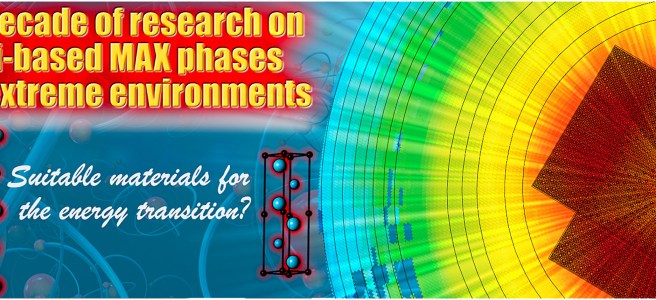
Can Ti-based MAX phases -- this new class of potential functional materials -- be applied in future nuclear reactors? We investigated the response of Ti-based MAX phases to both neutrons and heavy ions. The discoveries of this intense decade-long research has just been published at Materials Today Energy. Open access article access here: https://doi.org/10.1016/j.mtener.2022.101186
Nanocrystalline lightweight alloys for space exploration

We continue in our saga aiming at finding better radiation-resistant materials for applications in the extreme environment of the solar system. I am delighted to introduce you our new paper that was led by Patrick Willenshofer (another genius from Montanuniversitaet Leoben). In this paper, we introduce a revolutionary nanocrystalline crossover aluminium alloy that scored the … Continue reading Nanocrystalline lightweight alloys for space exploration
Rethinking Radiation Effects in Solids

With great pleasure I would like to share our most recent paper, which just got published at the Journal of Materials Science, edited by Professor C. Barry Carter. In this new article, we present an innovative methodology to rethink the way we investigate radiation effects in materials science: by using the Plasma Focused Ion Beam … Continue reading Rethinking Radiation Effects in Solids
Investigating the role of electronic energy loss in high-entropy alloys: comparison with ceramics!
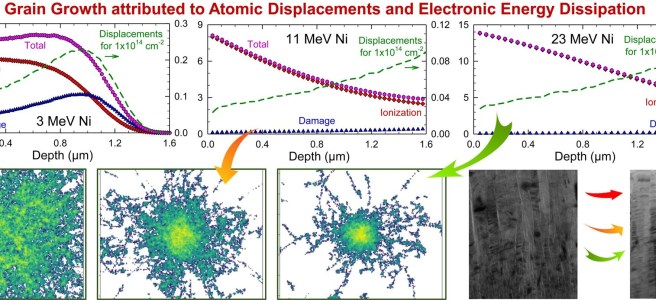
Just sharing with you friends a very interesting research article led by my friend and co-worker, Professor Yanwen Zhang, on the role of electronic energy loss in HEAs. We also do very nice comparison with ceramics! Online now at Current Opinion in Solid State and Materials Science, Elsevier! https://www.sciencedirect.com/science/article/pii/S1359028622000213
Nuclear Materials Highlights – Issue #2
Dear Friends! We would like to wish you an excellent 2022 start with great accomplishments in life and research! This year starts a great promise with the commission of the James Webb space telescope, which holds the future of astronomy and astrophysics! With the beginning of the new year, we will resume the Nuclear Materials … Continue reading Nuclear Materials Highlights – Issue #2
Metal alloy “hides” magnetic material with potential to enhance electronic devices
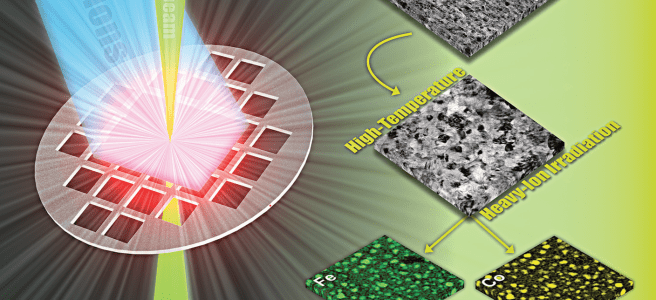
Despite their diminutive size, iron and cobalt nanoislands have strong magnetism, which can increase storage and data transfer capacity. Original story by Jornal da USP. Published: 01/10/2022 Updated: 01/11/2022 at 16:52 By Júlio Bernardes Researchers have evaluated the radiation resistance of highly concentrated metal alloys for use in nuclear reactors and have identified materials with … Continue reading Metal alloy “hides” magnetic material with potential to enhance electronic devices
Discovery of FeCo nanomagnets under irradiation in a high-entropy alloy
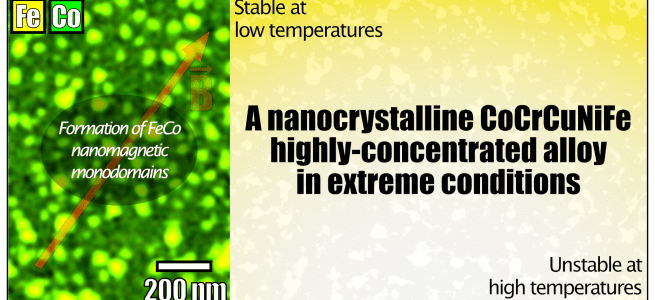
A modified version of the well-known Cantor's alloy, the nanocrystalline CoCrCuFeNi high-entropy alloy was subjected to heavy-ion irradiation in situ within a TEM in our most recent study within the field of potential new nuclear materials. The stability of the alloy was investigated in a broad range of irradiation doses and temperature, revealing the nucleation … Continue reading Discovery of FeCo nanomagnets under irradiation in a high-entropy alloy
 Materials at Extremes