MATDPA: Integration of SRIM2013 into MATLAB for nuclear materials calculations

I am happy to announce that the first public version of MATDPA is now available on GITHUB for public download. MATDPA is a collection of MATLAB scripts that I wrote to speed-up and automatize nuclear materials irradiation calculations. To install MATDPA in your machine (only Windows because Apple does not allow to run WINE anymore!), … Continue reading MATDPA: Integration of SRIM2013 into MATLAB for nuclear materials calculations

Professor Yanwen Zhang to join Queen’s University as a Canada Excellence Research Chair

Congratulations to Professor Yanwen Zhang on her appointment as the next Canada Excellence Research Chair for the Impact of Radiation in Energy and Advanced Technologies at Queen's University. As long-standing collaborators, we are proud to see her continue developing leading the next materials science for extreme environments! The team at materialsatextremes.com wishes her all the … Continue reading Professor Yanwen Zhang to join Queen’s University as a Canada Excellence Research Chair

Exploring the Stability of Ti-based MAX Phases in Extreme Nuclear Environments

We are excited to share findings from our latest research on the potential use of MAX phases in nuclear reactors. MAX phases, known for their hexagonal-compact nanolayered crystal structure, high machinability, and chemical inertness, have long been considered promising materials for nuclear applications. However, our new paper sheds light on crucial aspects that must be … Continue reading Exploring the Stability of Ti-based MAX Phases in Extreme Nuclear Environments

Advancing microreactor materials technology: Next stop, the Moon!

Miniaturizing nuclear reactors offers a robust solution for generating reliable and efficient electricity, crucial for supporting human missions beyond Earth. Such miniturization is not at all an easy task. I have been pursuing research in this area since 2015, when we designed a ~ 3x3 metre-sized small nuclear reactor core for biological shielding optimization studies. … Continue reading Advancing microreactor materials technology: Next stop, the Moon!

Metal Hydrides will Enable Space Exploration

I am glad to share with the community our newest paper on the fabrication of pure and bulk delta-phase Zirconium Hydride for use as moderators in microreactors. 50 days' free access here: https://authors.elsevier.com/c/1hv1X_UwYx0wLC Hydride moderators are envisaged for use in nuclear reactors for neutron thermalization, i.e., to reduce the kinetic energy of fast-born neutrons. This … Continue reading Metal Hydrides will Enable Space Exploration

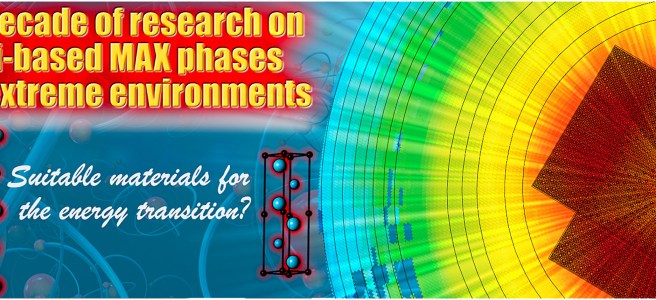
A decade probing the radiation response of Ti-based MAX phases

Can Ti-based MAX phases -- this new class of potential functional materials -- be applied in future nuclear reactors? We investigated the response of Ti-based MAX phases to both neutrons and heavy ions. The discoveries of this intense decade-long research has just been published at Materials Today Energy. Open access article access here: https://doi.org/10.1016/j.mtener.2022.101186

Nanocrystalline lightweight alloys for space exploration

We continue in our saga aiming at finding better radiation-resistant materials for applications in the extreme environment of the solar system. I am delighted to introduce you our new paper that was led by Patrick Willenshofer (another genius from Montanuniversitaet Leoben). In this paper, we introduce a revolutionary nanocrystalline crossover aluminium alloy that scored the … Continue reading Nanocrystalline lightweight alloys for space exploration

Investigating the role of electronic energy loss in high-entropy alloys: comparison with ceramics!

Just sharing with you friends a very interesting research article led by my friend and co-worker, Professor Yanwen Zhang, on the role of electronic energy loss in HEAs. We also do very nice comparison with ceramics! Online now at Current Opinion in Solid State and Materials Science, Elsevier! https://www.sciencedirect.com/science/article/pii/S1359028622000213