We have completed -- once and for all -- a full integration of MATLAB with the SRIM code. Now the MATLAB code features the possibility to calculate displacement-per-atoms (DPA) in a wide variety of conditions and using all existing DPA methodologies (R.E. Stoller with quick-damage and Y. Zhang with full cascades). Calculations are performed in … Continue reading MATLAB now fully integrated with SRIM!
Category: Nuclear Materials
The interplay of H in degrading Zr and its alloys
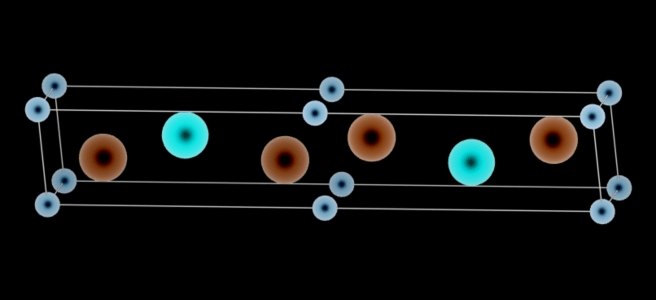
In a recent talk, I address the problem of H in deteriorating severely the properties of the most important metal in nuclear industry, Zr, due to the formation of the Zr hydrides. A throughout good paper H effects in metals was recently written by Professor Milos Djukic, which I highly recommend reading. Abstract The decision … Continue reading The interplay of H in degrading Zr and its alloys
First anthropogenic quasicrystal was synthesized under extreme conditions
An one-of-a-kind piece of research, Geologists and Geophysicists from Italy and USA discovered the first known antropogenic quasicrystal. It was synthesized during the first atomic test at Alamogordo in New Mexico (USA) in July 16th 1945. The research has been published in the Proceedings of the National Academy of Sciences. Link for the paper of … Continue reading First anthropogenic quasicrystal was synthesized under extreme conditions
Cr-based MAX phase as potential nuclear materials
Ceramics are known to amorphise under energetic particle irradiation. We show Cr2AlC MAX phase -- even in its non-pure semi-crystalline form -- can resist to amorphisation when in its grain-size falls into the nanocrystalline regime (10-100 nm)! Free access at: https://doi.org/10.1126/sciadv.abf6771
This is Zircaloy-4: the material that revolutionized the nuclear industry.
This is from my archives (2013), I found this beautiful piece of video showing Zircaloy-4 being cut in a Lathe and firing up at the Polytechnic School of University of São Paulo, the place where I proudly did my master in metallurgy with focus in nuclear engineering and nuclear materials under Professor C.G. Schön! Beautiful … Continue reading This is Zircaloy-4: the material that revolutionized the nuclear industry.
High-entropy alloys are indeed radiation resistant. What about the high-entropy?
In another great collaboration with Oak Ridge National Laboratory and Universities of Huddersfield, Leoben and São Paulo, we have investigated in depth the radiation response of a FeCrMnNi high-entropy alloy (HEA) compared with a commercial austenitic stainless steel. Yes, the HEA outperforms the steel by a 80% margin when thermodynamic stability of the matrix phase … Continue reading High-entropy alloys are indeed radiation resistant. What about the high-entropy?