
We are excited to share findings from our latest research on the potential use of MAX phases in nuclear reactors. MAX phases, known for their hexagonal-compact nanolayered crystal structure, high machinability, and chemical inertness, have long been considered promising materials for nuclear applications. However, our new paper sheds light on crucial aspects that must be examined further to harness their potential fully.
The focus of this study is on two titanium-based MAX phases: Ti2AlC and Ti3SiC2. These materials were evaluated under the harsh conditions typical of nuclear reactors, involving high temperatures and exposure to energetic particle irradiation. Through a comparative analysis that spanned over a decade of research at the high flux isotope reactor (HFIR at the Oak Ridge National Laboratory), and included both neutron and heavy-ion irradiations performed in situ in a transmission electron microscope at the prestigious MIAMI-2 facility, we have gained new insights.
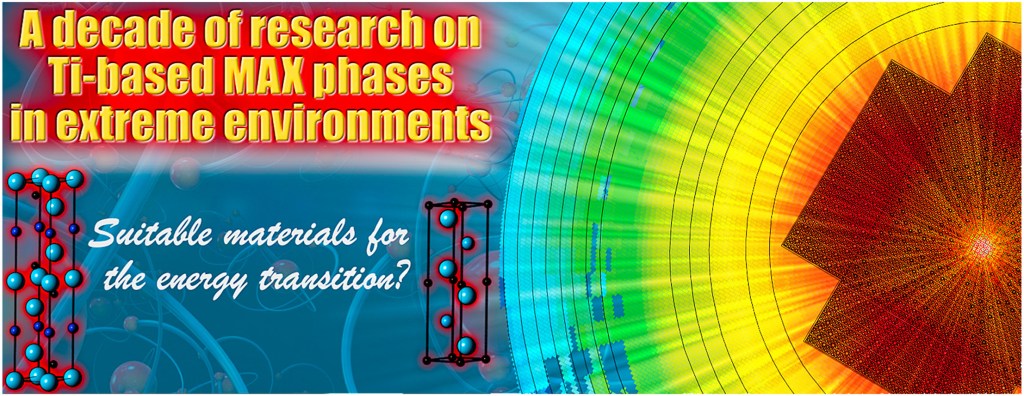
Our findings indicate that Ti-based MAX phases are more susceptible to accelerated decomposition than previously thought, particularly under the extreme conditions studied and at high-temperatures. This challenges the existing hypothesis of their high phase stability, raising significant questions about their suitability for future nuclear energy systems, where energetic particle irradiation is a key factor in material degradation.
This research opens up new avenues for investigating degradation mechanisms in MAX phases and highlights the need for continued exploration of these materials. For more details on our findings and their implications, you can access the open access full paper: https://www.sciencedirect.com/science/article/pii/S2468606922002441.
Stay tuned for more updates as we delve deeper into the capabilities and limitations of MAX phases in nuclear technology. Your thoughts and discussions are welcome, as they enrich our community’s understanding and drive further scientific advancements.

 Materials at Extremes