

At the Chair of Nonferrous Metallurgy, the [X-MAT] team has had an extraordinary year, delivering transformative insights into materials science for extreme environments. From enabling portable power for space missions to improving sustainable energy solutions and advancing future fusion-based nuclear technologies, our work continues to push the boundaries of what materials can achieve.
This retrospective highlights some publications from 2024, focusing on their innovations, applications, and impact.
1. Space Applications: Materials for the Final Frontier
Space exploration demands materials that can withstand intense radiation, high temperatures, and compact designs. This year’s research made significant contributions in meeting these challenges, specially in the development of suitable materials for applications in nuclear microreactors:
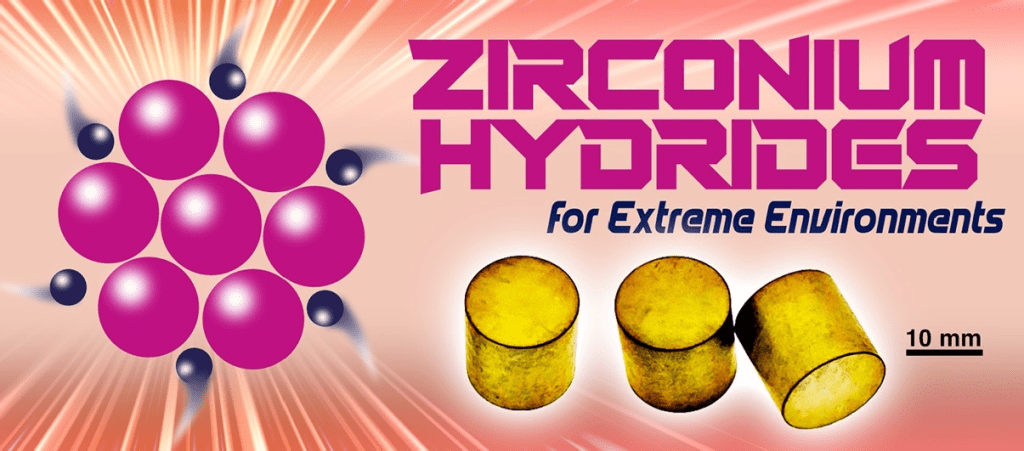
Delta-Phase Zirconium Hydride for Microreactors
The fabrication of delta-phase Zirconium Hydride (δ-ZrHx) using Zircaloy-4 opens new possibilities for microreactors—compact nuclear power sources essential for space missions. The study revealed:
– Formation of Sn-rich segregation zones due to hydriding.
– Effects of hydriding on Zr(Fe,Cr)₂ Laves phases, which influence material stability.
These insights directly impact the development of efficient neutron moderators for space-based nuclear reactors, ensuring reliable energy sources for lunar bases, Mars habitats, and beyond.
Yttrium Dihydride: A Stable Neutron Moderator
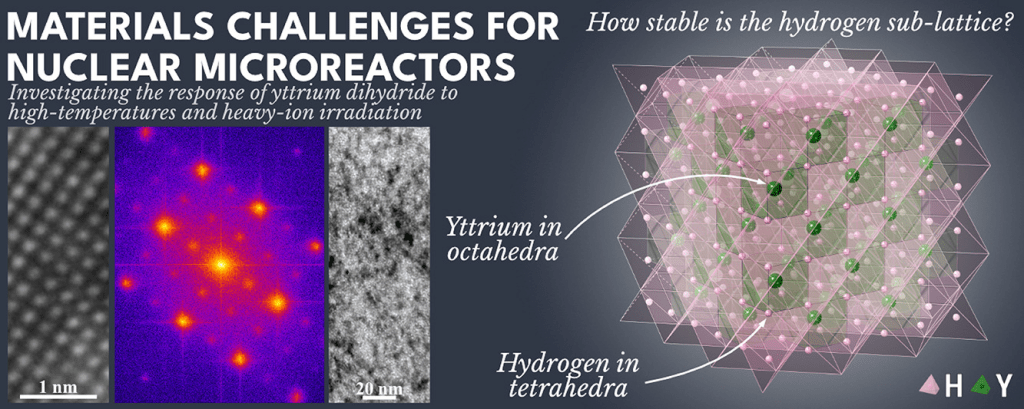
The investigation of Yttrium Dihydride (YH₂) as a neutron moderator demonstrated remarkable stability under heavy ion irradiation up to 800°C and 2 dpa. Highlights include:
– Resilience against phase changes, precipitation, or amorphization.
– Void formation as the primary radiation damage mechanism.
This makes YH₂ a top candidate for neutron moderation in microreactors, critical for power generation in compact, weight-sensitive spacecraft designs.
2. Sustainable Energy Solutions
The global push for sustainability requires innovative materials for energy storage and conversion technologies. [X-MAT] research tackled key challenges:
Corrosion Resistance in Aluminum PEMFCs
Aluminium’s potential as a lightweight, cost-effective material for proton exchange membrane fuel cells (PEMFCs) hinges on improved corrosion resistance. A study on TiN-coated aluminum bipolar plates showed:
– Enhanced corrosion resistance in simulated PEMFC environments.
– The ability to tailor performance through synthesis parameters.
These findings support the commercialization of PEMFCs as a viable, sustainable energy solution. Aluminium emerges now as an strategic material for fuel cells, given its corrosion resistance is enhanced with appropriate coatings!

Hydrogen Embrittlement Challenges
Despite hydrogen’s promise as a clean energy carrier, its impact on materials remains a critical hurdle. This year’s review highlighted:
– Deficiencies in nanoatomic-scale hydrogen detection techniques.
– The need for advanced experimental methods to map hydrogen interactions within microstructures.
The review paper was elected one of the “best papers of the year 2024” for the Advanced Engineering Materials, standing out in first place in the list! It was also featured with a back cover page in the journal’s issue.

3. Innovations in Nuclear Materials: Moving fast towards fusion energy!
[X-MAT] research made groundbreaking contributions to nuclear technology by developing alloys and ceramics for extreme conditions:
Radiation-Resistant Refractory Medium-Entropy Alloys
Refractory Medium-Entropy Alloys (RMEAs) like WTaV offer exceptional radiation tolerance while simplifying fabrication compared to high-entropy counterparts. Key findings include:
– Tailoring the W-Ta-V system’s radiation response through vanadium concentration.
– Validation of experimental results using Monte Carlo simulations and ab initio modeling.

High-Entropy Ceramics for Fusion Reactors
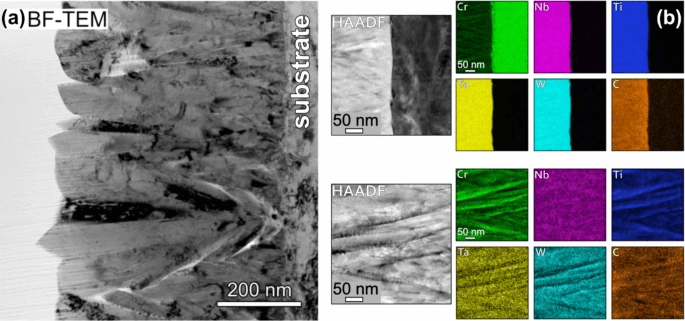
The development of near-equimolar (CrNbTaTiW)C coatings demonstrated resilience under heavy ion irradiation at 573 K, including:
– Structural stability up to 8.5 dpa.
– Elemental redistribution that improved solid-solution homogeneity.
These materials pave the way for safer and more efficient nuclear fusion technologies.
4. Advancing Aluminum Alloys
Aluminium remains central to lightweight, high-performance materials. [X-MAT] publications in collaboration with the research group of Professor Stefan Pogatscher unveiled exciting advancements:
Cluster Hardening with Cu in Al-Mg-Si Alloys
By adding Cu, Philip Aster achieved a fourfold increase in ductility without compromising strength. This breakthrough opens possibilities for:
– High-strength structural materials with improved formability.
– Applications in aerospace, automotive, and renewable energy sectors.

Comparative Microstructural Characterization Techniques
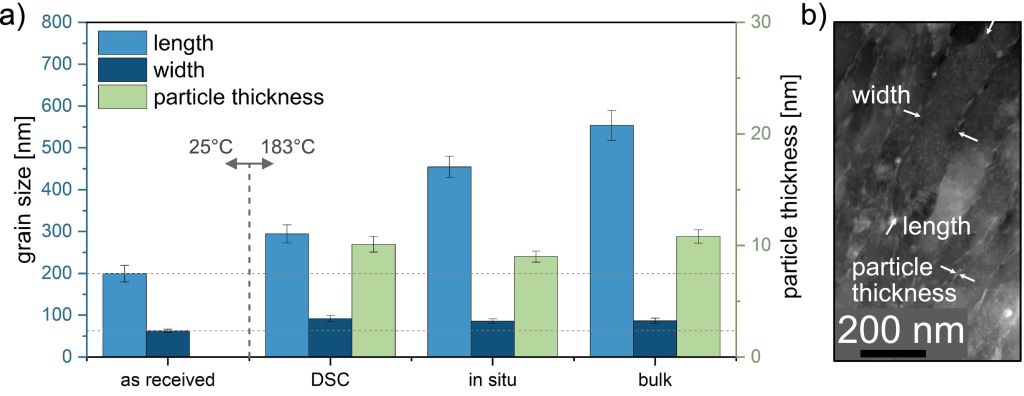
Patrick Willenshofer developed a novel approach to studying precipitation sequences in nanostructured aluminum alloys compared:
– Ex situ TEM from bulk heating and TEM foil heating.
– In situ TEM using MEMS heating.
This work provides a comprehensive framework for understanding heat treatment effects on microstructures from coarse-to-nano grains.
5. Developing Nanometallurgy
As devices shrink, materials science must address nanoscale phenomena. This year’s studies included:
Behavior of Cu Nanowires
Investigations into Cu nanowires under low-pressure heating revealed:
– Sublimation as the dominant effect above 1023 K.
– Steady-state length reduction linked to vapor pressure increases.
These findings contribute to the miniaturization of electronic components while maintaining stability under extreme conditions. For nanometals and nanoalloys, the “extreme” conditions parameter is very different from bulk materials: Diego Corradini’s paper on Nanotoday explores this phenomenon in further detail using advanced electron microscopy techniques.

The [X-MAT] projects of 2024 research reflects a dedication to solving some of the most pressing challenges in materials science. From space exploration to sustainable energy and nuclear technologies, our publications have advanced understanding and inspired new possibilities. As we move into 2025, X-MAT remains committed to driving innovation in materials for extreme environments.
As the holiday season is upon us, we extend our warmest wishes to all our collaborators, readers, and supporters. May this Christmas bring you joy, and the New Year be filled with success, inspiration, and new achievements.

As scientists, we are reminded of our shared responsibility to pursue knowledge, foster world’s peace, and contribute to the betterment of society. Advancing science in service of humanity is our mission, and we remain steadfast in this commitment for the years to come.
Merry Christmas and a prosperous New Year!
Mattzi

 Materials at Extremes