

Aluminium crossover alloys are one of the more interesting recent developments in light metals. Rather than staying within the traditional wrought families, they deliberately blend the chemistries of the AA5xxx and AA7xxx systems, and in doing so they form the compositionally complex T-phase, Mg32(Al,Cu)49, which gives a remarkable hardening response and has already attracted serious industrial interest. Until now, though, that entire story has been a wrought one: T-phase precipitates develop during slow cooling or carefully controlled ageing treatments in conventional sheet manufacturing. Nobody had asked what happens to this alloy family under a laser.
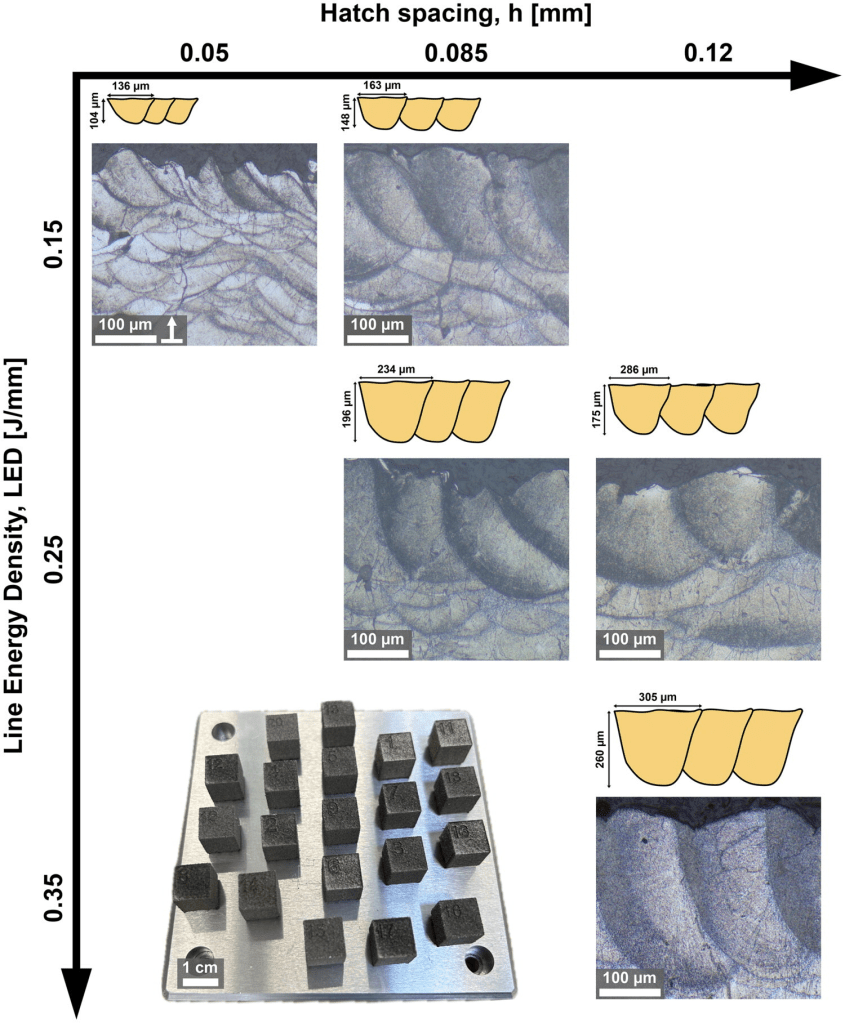
In this new open-access paper in European Journal of Materials, Andreas Weidinger and colleagues do exactly that, taking the commercial AMAG CrossAlloy .57 through Powder Bed Fusion – Laser Beam/Metal for what is, to the best of the authors’ knowledge, the first time. The printing method itself is entirely standard, an off-the-shelf EOS M290 with a 370 W fibre laser, but the pairing is new, and the work behind it is thorough: 55 parameter sets screened, then narrowed to a stable window at a volumetric energy density of 70 J/mm³ and a line energy density of 0.125 to 0.150 J/mm, yielding relative densities above 98.5 per cent.
The results are a genuine surprise, and not entirely a comfortable one. Electron microscopy revealed coarse Mg–Zn–Al–(Cu)-rich precipitates, several hundred nanometres across and frequently nucleated on Fe-rich dispersoids, with morphologies that have never been reported in conventionally processed crossover alloys. Alongside them sits a second population of nanoscale Zn- and Mg-enriched precipitates, apparently nucleated on dislocations during the cyclic reheating of layer-by-layer deposition.
The catch here in this system and method is evaporation: magnesium and zinc boil off under the laser, with zinc losses exceeding 23 per cent and the Mg/Zn ratio drifting from 1.28 towards 1.44. FactSage calculations confirm that this depleted chemistry simply cannot reach the T-phase fraction available in the wrought condition, and the mechanics follow: 180 to 230 MPa tensile strength, elongation below one per cent, and brittle fracture initiating at lack-of-fusion defects and hot cracks whatever the heat treatment. Ageing still works, reaching 117 HBW, but the strengthening is masked by the defect population. The conclusion is the useful one: wrought crossover chemistries cannot simply be poured into a printer, and integrated alloy–process co-design is needed instead.
Warmest congratulations to our friend Andreas Weidinger, who is completing his PhD under Professor Stefan Pogatscher at Montanuniversität Leoben, on leading this study. The paper is open access, so please do read it in full. This is also our first paper on the European Journal of Materials, which makes me very happy!

Weidinger, A., Riabov, D., Samberger, S., Dumitraschkewitz, P., Weißensteiner, I., Schmid, F., Stemper, L., Tunes, M. A., Nyborg, L., & Pogatscher, S. (2026). Al–Mg–Zn–(Cu) crossover alloy for Powder Bed Fusion – Laser Beam/Metal: Processing–microstructure–property relationships. European Journal of Materials, 6(1), 2718638. https://doi.org/10.1080/26889277.2026.2718638


