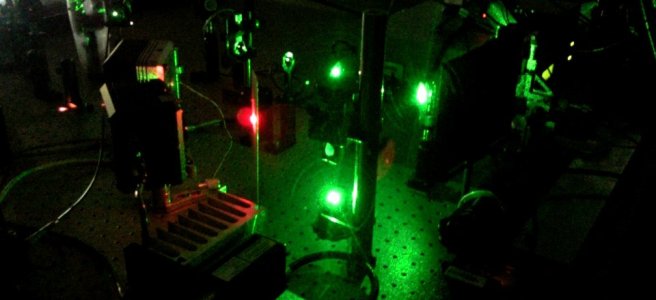
Ultrafine-grained (UFG) aluminium alloys are strong candidates for space structures: their dense grain-boundary network acts as sinks that absorb radiation-induced defects (more in our perspective review https://doi.org/10.1021/acsmaterialsau.5c00139). But that advantage only survives if the microstructure does — and in Low-Earth Orbit, sunlit components reach ~200 °C, right where severely deformed aluminium begins to recrystallise. The … Continue reading One-grain-at-a-time: how in situ EBSD rewrote sink-strength theory for space aluminium
Tag: Montanuniversität Leoben
Professor Milos Djukic Brings Hydrogen Masterclass to Leoben
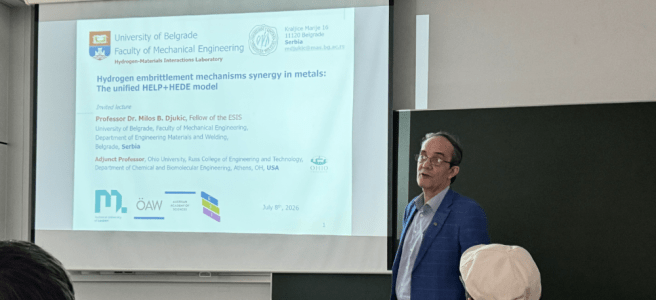
This week we had the great pleasure of welcoming Professor Milos B. Djukic (University of Belgrade, Faculty of Mechanical Engineering) to Leoben — a world-class authority on hydrogen embrittlement and one of the most influential voices in the field today. Professors Djukic and Keckes at ESI. Professor Djukic visited at the invitation of Professor Jozef … Continue reading Professor Milos Djukic Brings Hydrogen Masterclass to Leoben
A new way to “see” inside aluminium alloys
What if a single microscope image could simultaneously show nanoclusters, dislocations, grain boundaries, and corrosion pores – all in under a minute? We have found a way to do exactly that and we described recently in a paper published it in Small Methods! The method, called differential phase contrast (DPC), is not new to electron … Continue reading A new way to “see” inside aluminium alloys
Battery waste is worth billions!
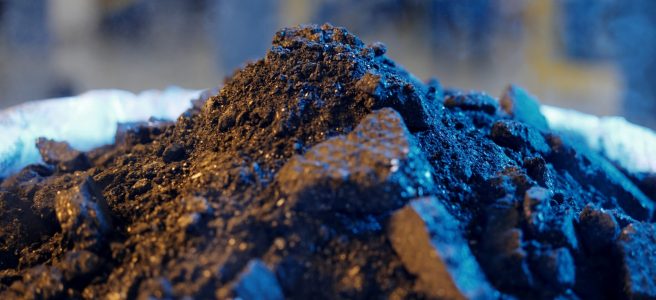
As the world accelerates its transition to electric vehicles and renewable energy, the pressure to recycle lithium-ion batteries efficiently has never been greater. At the heart of most recycling processes sits a fine black powder called black mass — a mixture of cathode and anode materials, binder residues, and metallic fragments recovered from spent batteries. … Continue reading Battery waste is worth billions!
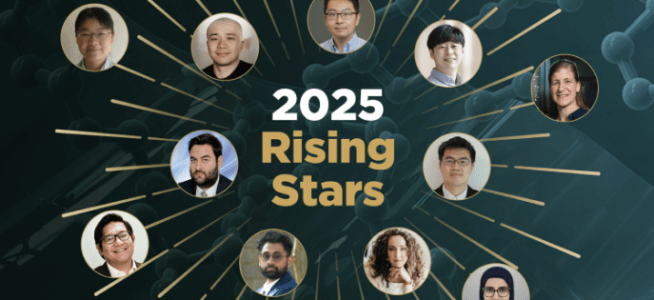
Grateful to be among the 2025 Rising Stars in Materials Science
I am deeply humbled and grateful to the American Chemical Society and the editors of ACS Materials Au for selecting me as part of the 2025 class of Rising Stars in Materials Science. This recognition came as a wonderful surprise, and I am truly thankful to be included alongside 13 other outstanding early-career researchers from … Continue reading Grateful to be among the 2025 Rising Stars in Materials Science
New Preprint: Unlocking Nanoscale Detail in Aluminium Alloys with DPC Segmentation
We are pleased to share our latest preprint, now available on arXiv: Unlocking nanoscale microstructural detail in aluminium alloys through differential phase contrast segmentation in STEM (arXiv:2603.11643). In this work, we show how differential phase contrast (DPC) imaging in scanning transmission electron microscopy can be turned into a powerful, quantitative tool for characterising the microstructures … Continue reading New Preprint: Unlocking Nanoscale Detail in Aluminium Alloys with DPC Segmentation
Atom-by-atom materials shaping future technology
What will the materials powering tomorrow's clean energy systems, quantum computers, and deep-space missions actually be made of — and how do we design them? We are thrilled to share our latest featured article in The European magazine, where we explore how cutting-edge research is engineering matter at the atomic scale. From the nanolaminated MAX … Continue reading Atom-by-atom materials shaping future technology
“Zigzag Atoms: Scientists develop material with high technological potential” — The University of São Paulo
Our interview to the Brazilian newspaper "Jornal da USP" is now online! "Zip Phases," synthetic materials combining metallic and non-metallic chemical elements, could be used in the future in electronics, energy storage, superconductivity, and sensors. A new class of synthetic intermetallic materials, with unique atomic structures and physical properties offering high technological potential, has been … Continue reading “Zigzag Atoms: Scientists develop material with high technological potential” — The University of São Paulo
Leoben makes waves in fusion materials research
The [X-MAT] team at the Chair of Nonferrous Metallurgy, Montanuniversität Leoben, has drawn global attention with a groundbreaking study published in Advanced Science (DOI: 10.1002/advs.202417659). With more than 1k views and reads in the journal's first month after publication, our work challenges the prevailing high-entropy alloy (HEA) paradigm by proving that even simpler alloy systems can outperform their … Continue reading Leoben makes waves in fusion materials research
The Great Mentor of World’s Non-Ferrous Metallurgy
It is with great pride and heartfelt congratulations that we celebrate the recent recognition of Professor Peter Uggowitzer, who was awarded the Great Badge of Honour of the State of Styria on 12 May 2025 in a formal ceremony at the Old University in Graz. The honour was presented by Governor Mario Kunasek and Deputy … Continue reading The Great Mentor of World’s Non-Ferrous Metallurgy