
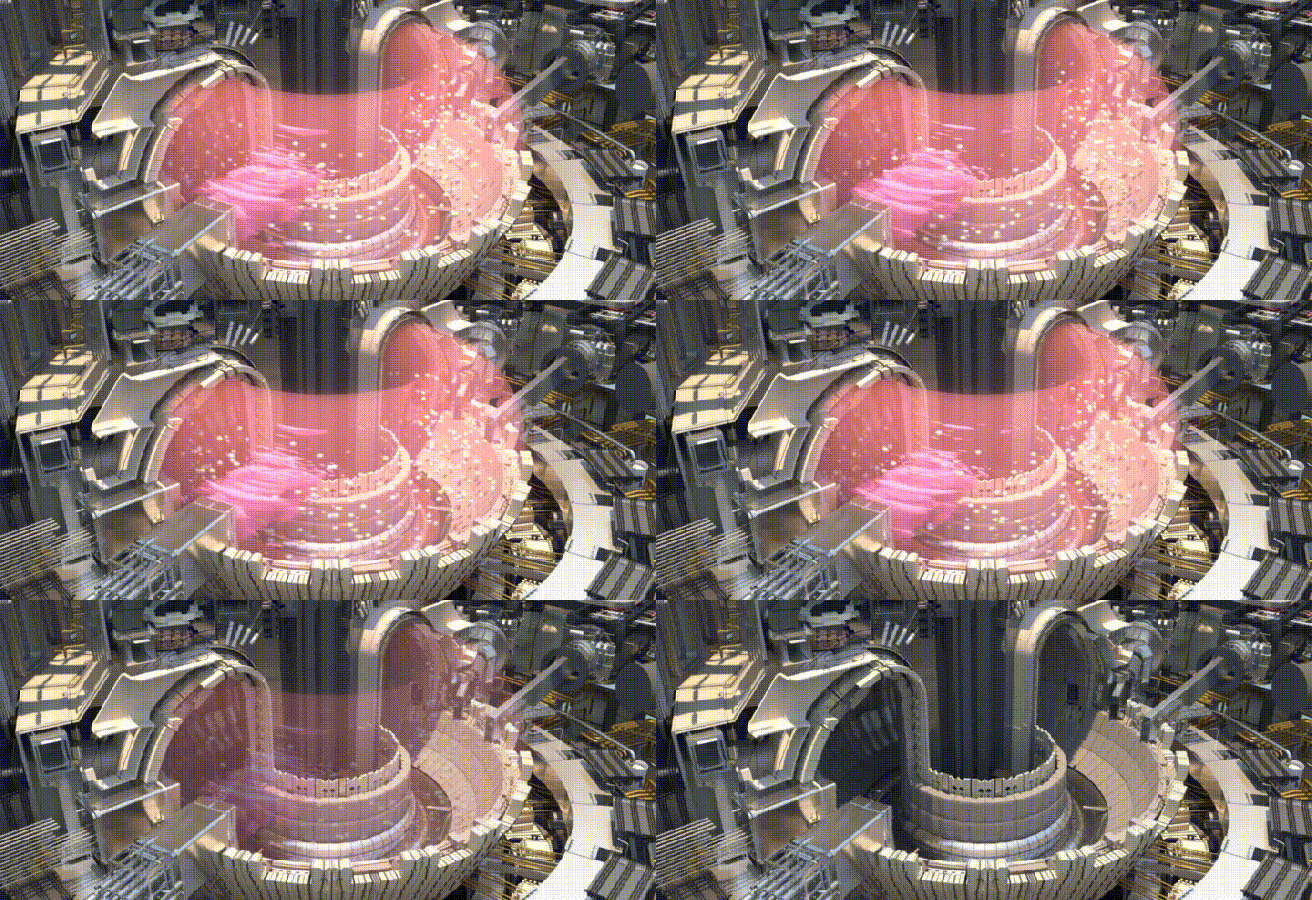
We are delighted to share a new preprint that takes on one of fusion energy’s most stubborn materials problems: building a heat sink that can survive inside a reactor. Commercial fusion demands components that withstand intense neutron bombardment while extracting punishing heat loads for conversion to electricity, and CuCrZr — a copper alloy strengthened by a fine dispersion of nano-precipitates formed during prime-ageing — is the leading candidate for the job. But whether that precipitation-hardening strategy can actually survive fusion-relevant irradiation had never been put to the test. This work set out to find out.
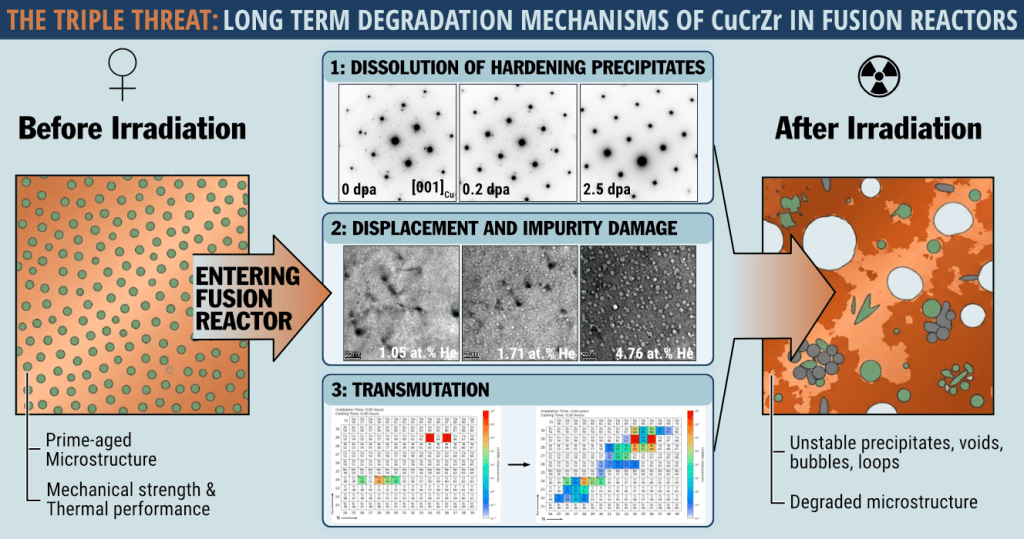
Combining in situ transmission electron microscopy under heavy-ion irradiation and helium implantation with thermodynamic and transmutation modelling, the study delivers the first joined-up picture of how a prime-aged copper microstructure evolves under fusion conditions. It reveals that the hardening precipitates respond through two distinct kinetic regimes — ballistic dissolution at low temperatures, dissolution and re-precipitation at higher ones — while helium bubbles and krypton-rich voids emerge as vacancies become mobile and transmutation gradually steers the alloy chemistry towards Ni–Zr intermetallics over a service lifetime. Bringing these mechanisms together in one framework is a ground-breaking step, and it opens a genuinely exciting frontier for the metallurgy of copper: the design of a new generation of Cu-based heat-sink alloys engineered to hold their strength even as the neutron spectrum reshapes them, thermodynamically and ballistically, from the inside out. It is a roadmap as much as a result.
A special word for Thomas Barzic, whose master’s work this is. It is a remarkable debut — rigorous, imaginative, and unafraid of a genuinely hard problem — the kind of preprint any researcher would be proud of at any stage of their career. Huge congratulations, Thomas, and our sincere thanks to the European School of Materials (EEIGM, Nancy) for funding Mr. Barzic and to Univ.-Prof. Dr. Raul Bermejo for all the support to our international student exchange programs at the Montanuniversität Leoben. We cannot wait to see what you do next.
Citation: T. Barzic, A.-C. Seitlinger, C. Frühwirth, E. McDonald, J. Tang, J. A. Hinks, A. Zinovev, D. Terentyev, S. Luidold, C. G. Schön, E. Jimenez-Melero, S. Pogatscher, M. A. Tunes, “CuCrZr heat-sink irradiation performance reveals new challenges for thermonuclear fusion reactors,” arXiv:2607.17594 (2026). https://arxiv.org/abs/2607.17594


you are amazing—–“Materials
LikeLiked by 1 person