
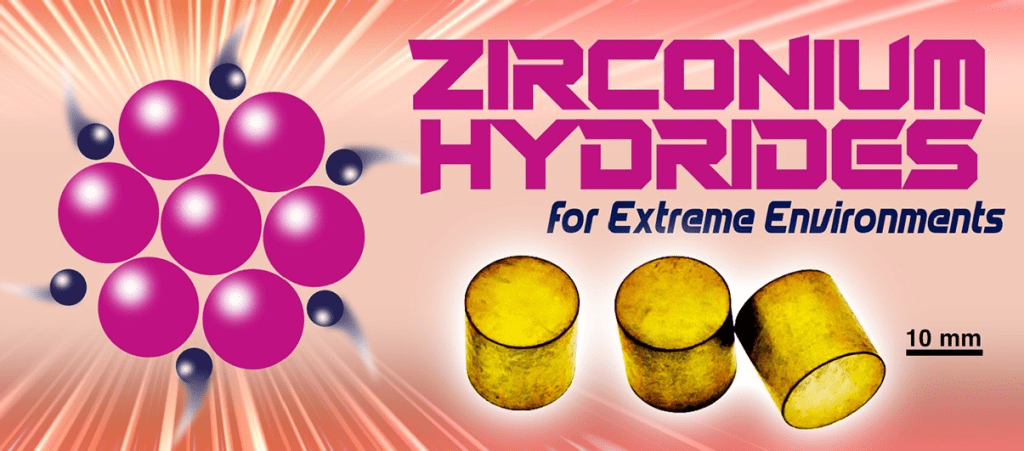
I am glad to share with the community our newest paper on the fabrication of pure and bulk delta-phase Zirconium Hydride for use as moderators in microreactors.
Hydride moderators are envisaged for use in nuclear reactors for neutron thermalization, i.e., to reduce the kinetic energy of fast-born neutrons. This is a marvelous scientific problem that Enrico Fermi and colleagues began to experimentally investigate in early 1939 (Anderson-Fermi-Szilard, Physical Review 562, 284-286, 1939).
Immediately after the discovery of nuclear fission by Lise Meitner (Meitner and Hahn, Nature 2615, 239-240, 1939), Fermi and his team were highly motivated to stabilize this new nuclear reaction in order to demonstrate feasibility for sustained nuclear reactor power generation, but the nuclear fission could only be achieved with neutrons in the thermal region of the energy spectrum, considering uranium-based fuels. In the words of Anderson:
(…) We may conclude that a nuclear chain reaction could be maintained in a system in which neutrons are slowed down without much absorption until they reach thermal energies and are then mostly absorbed by uranium rather than by another element. It remains an open question, however, whether this holds for a system in which hydrogen is used for slowing down the neutrons.”
Anderson-Fermi-Szilard, Physical Review 562, 284-286, 1939
The issue had shifted from physics to materials science. Physicists recognized hydrogen’s remarkable potential for neutron moderation, but producing a hydrogen-based material suitable for design on a large scale was not feasible at the time. Leo Szilard was the voice that opted for graphite instead (W. Lanouette. Genius in the shadows: a biography of Leo Szilard, the man behind the bomb, Skyhorse 2013).
In our present paper, we demonstrate the feasibility to produce phase-pure zirconium hydride in a form of pellets to fuel future microreactors, where geometrical dimensions is a concern that requires the use of solid-state and effective moderators. We also discovered that in the regime of high hydrogen concentrations, a dealloying effects exists, experimentally validating previous ab initio calculations. This work unravels important science in the domain of hydrogen-materials interaction in a regime not very much explored.
I’m especially delighted with this new publication as it marks the debut paper from the PhD work of one of the brightest nuclear engineers and scientists I’ve ever collaborated with, Ms. Darren Parkison, from UC Berkeley in the USA. Congratulations Darren on this parvum opus!
Ah! These bright students… Glück auf!
D. Parkison, M.A. Tunes, T.J. Nizolek, T.A. Saleh, P. Hosemann, C.A. Kohnert
Fabrication of bulk delta-phase Zirconium Hydride from Zircaloy-4 for use as moderators in microreactors.
Scripta Materialia 239, 115771, 2024. https://doi.org/10.1016/j.scriptamat.2023.115771


 Materials at Extremes