

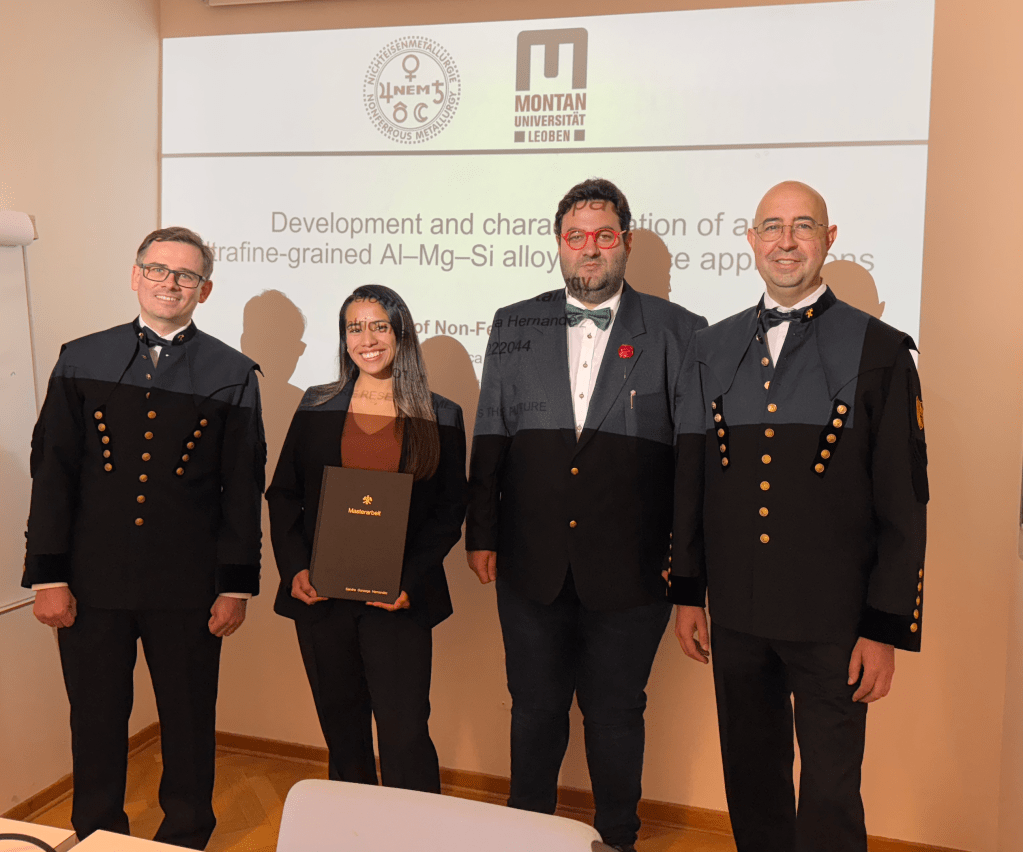
On October 1, 2024, Sandra Gonzaga, our Master Student, reached an impressive milestone in her academic journey, successfully defending her Master’s thesis with the highest grade of “Sehr gut” (1). Her remarkable research has broken new ground in the study of aluminium alloys within the Al–Mg–Si system, designed specifically for space applications.
Aluminium alloys, particularly AA6061, have long been considered a leading candidate for space structures due to their high strength-to-weight ratio and excellent thermal performance. However, as space technology advances, new challenges arise, including the need for materials that can withstand the extreme environment of space — particularly energetic particle irradiation, which can degrade the alloy’s performance.
In efforts to mitigate radiation damage in commercial aluminium alloys within the AA6061 designation, Sandra’s work took a bold step by synthesizing and an new ultrafine-grained (UFG) AA6061 alloy. Using one severe plastic deformation technique known as high-pressure torsion (HPT), she successfully developed a AA6061 UFG alloy within the AA6061 and evaluated its behavior under heat treatment and thermal loading, the latter mimicking the limits of applicability in low-Earth orbit conditions (LEO).
Through an array of advanced techniques such as differential scanning calorimetry (DSC) and scanning transmission electron microscopy (S/TEM), Sandra compared the precipitation behavior and thermal stability of the UFG AA6061 alloy to its coarse-grained (CG) counterpart. One of the key findings was the accelerated precipitation process in UFG alloys, leading to the rapid formation of equilibrium phases and less favorable precipitation behavior compared to the CG version.
While UFG AA6061 showed limited precipitation ability and recrystallized at lower temperatures (around 180°C), Sandra’s research highlights the alloy’s limitations for space applications. The thesis also draws a crucial comparison between UFG AA6061 and other aluminium alloys, such as the crossover alloy AlMgZnCuAg, which exhibits superior thermal stability due to higher volumetric density of precipitates, the T-phase: a topic currently under investigation by Patrick Willenshofer.
Sandra’s work not only enhances our understanding of UFG aluminium alloys but also positions her research as a vital contribution to future space exploration materials. Her outstanding achievement represents an important step forward in designing stronger, more radiation-resistant alloys for space.
Congratulations, Sandra, on your well-deserved success! Your dedication to learn multiple experimental techniques in less than one year, and your strive desire to get up-to-date with the complex literature of both space materials and aluminium alloys have truly set the stage for exciting advancements in space materials and metallurgy in extreme environments.
The community will soon grain a nice publication reporting on Sandra’s thesis results!
A Glück Auf from a proud and humble mentor!

 Materials at Extremes
Congratulation to this wonderful achievement !!
LikeLiked by 1 person