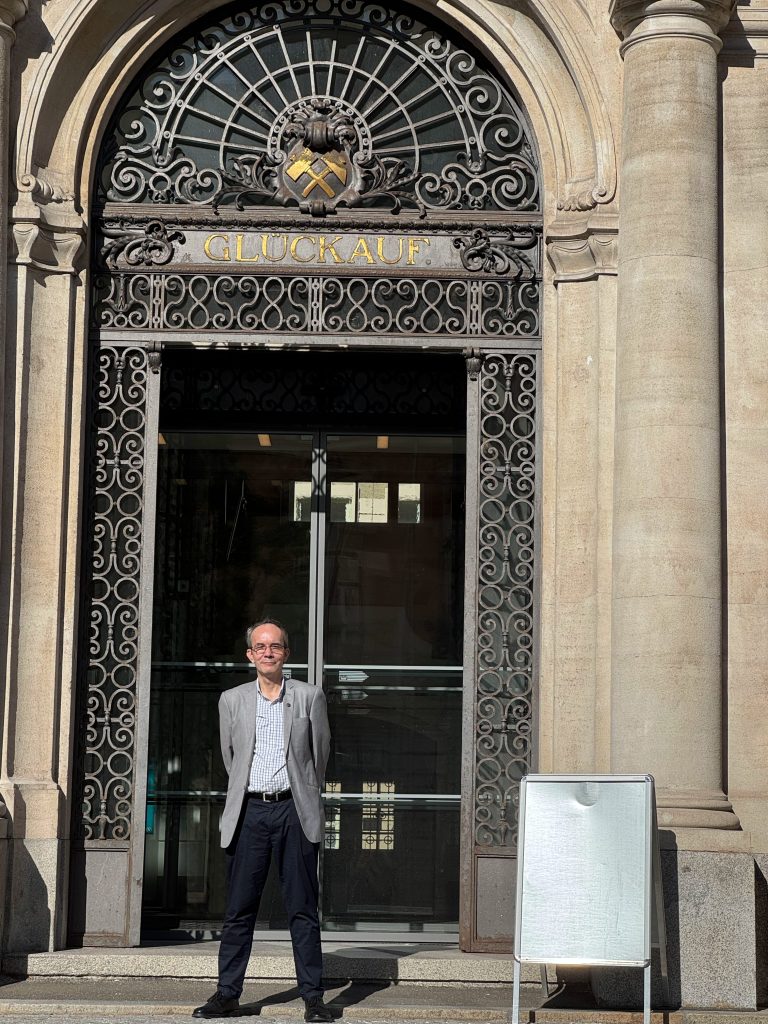
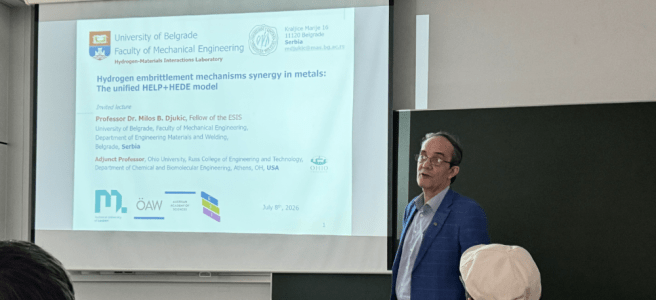
This week we had the great pleasure of welcoming Professor Milos B. Djukic (University of Belgrade, Faculty of Mechanical Engineering) to Leoben — a world-class authority on hydrogen embrittlement and one of the most influential voices in the field today.
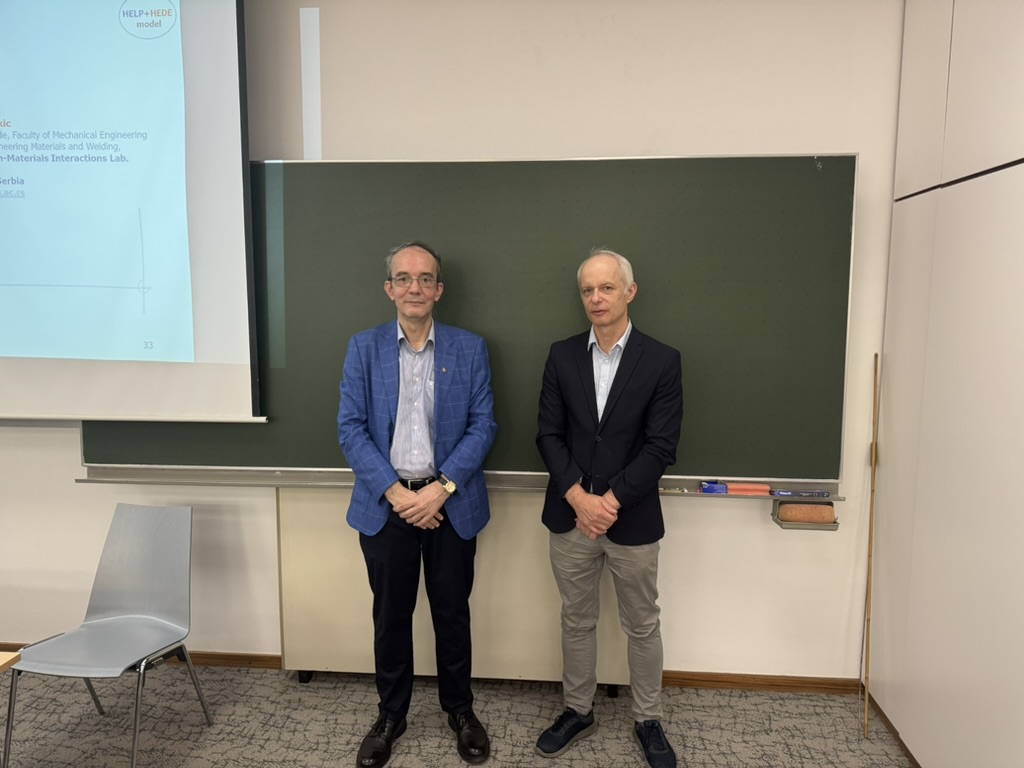
Professor Djukic visited at the invitation of Professor Jozef Keckes, who is a Full Professor at the Chair of Materials Physics, Department Materials Science of the Montanuniversität Leoben. Professor Djukic was invited by Professor Keckes under the authority of the Austrian Academy of Sciences at the Erich Schmid Institute of Materials Science. The highlight of the visit came on Wednesday, 8 July, when he delivered an invited lecture at the Erich-Schmid-Kolloquium: Hydrogen embrittlement mechanisms synergy in metals: The unified HELP+HEDE model. The seminar room was packed to the last seat — a full house — and the talk was met with a wide and enthusiastic reception, followed by a full hour of lively discussion that could easily have run longer.
Why hydrogen embrittlement matters
Hydrogen is the smallest atom in the universe, and that is precisely the problem. It slips into metals almost unnoticed and, once inside, can turn tough, ductile alloys unexpectedly brittle — a phenomenon that has plagued engineers for over a century and now stands squarely in the path of the emerging hydrogen economy. Pipelines, storage tanks, turbines, reactors: none of it works unless we understand how hydrogen degrades the metals it touches.
For decades, the field was divided between competing explanations — does hydrogen enhance localised plasticity (HELP), or does it weaken atomic bonds outright (HEDE)? Professor Djukic’s unified HELP+HEDE model cut through this debate by showing that the two mechanisms coexist, compete, and trade dominance depending on local hydrogen concentration, microstructure, and stress state. His recent concept of “local HEDE micro-incidents” — discrete micro-scale crack initiation events at hydrogen-prone traps in the microstructure — explains how a material can shift from plasticity-dominated behaviour to sudden, sharp losses in ductility. It is a framework that has reshaped how the community thinks about hydrogen damage, validated by experiments and modelling studies worldwide.
Beyond the lecture
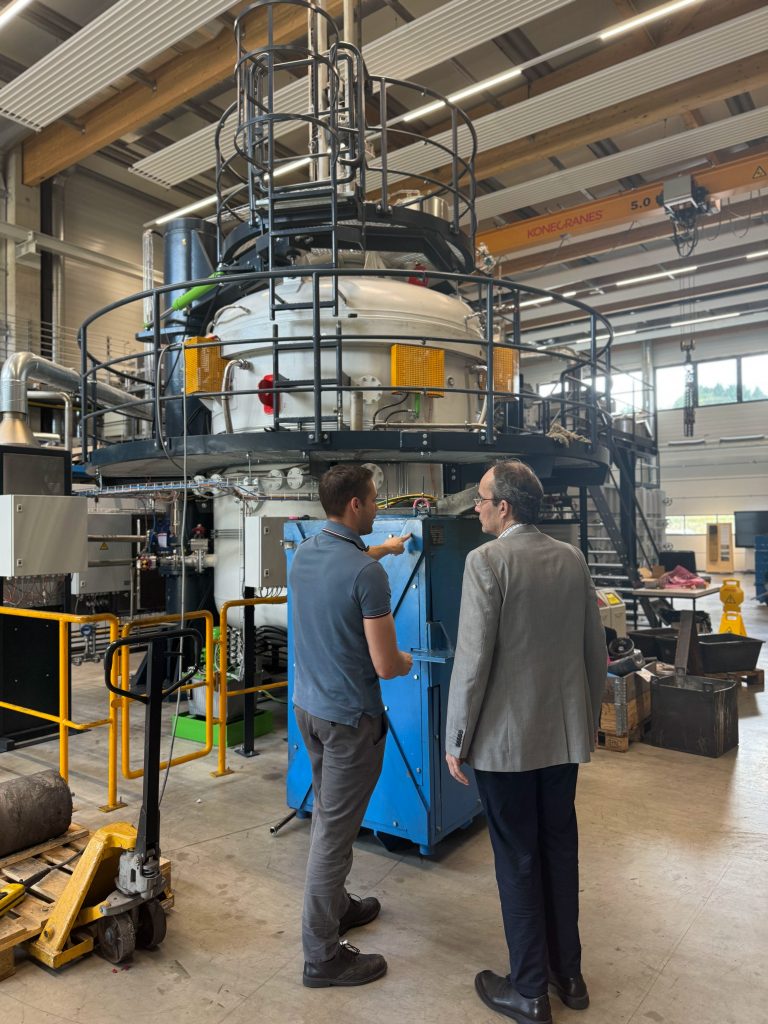
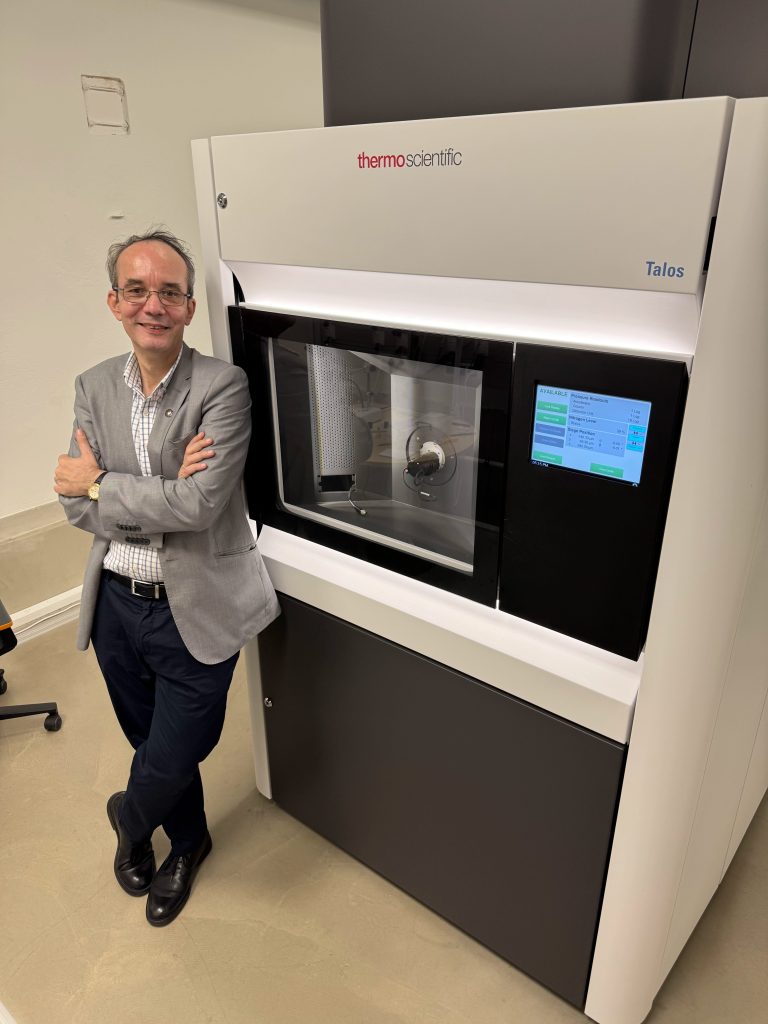
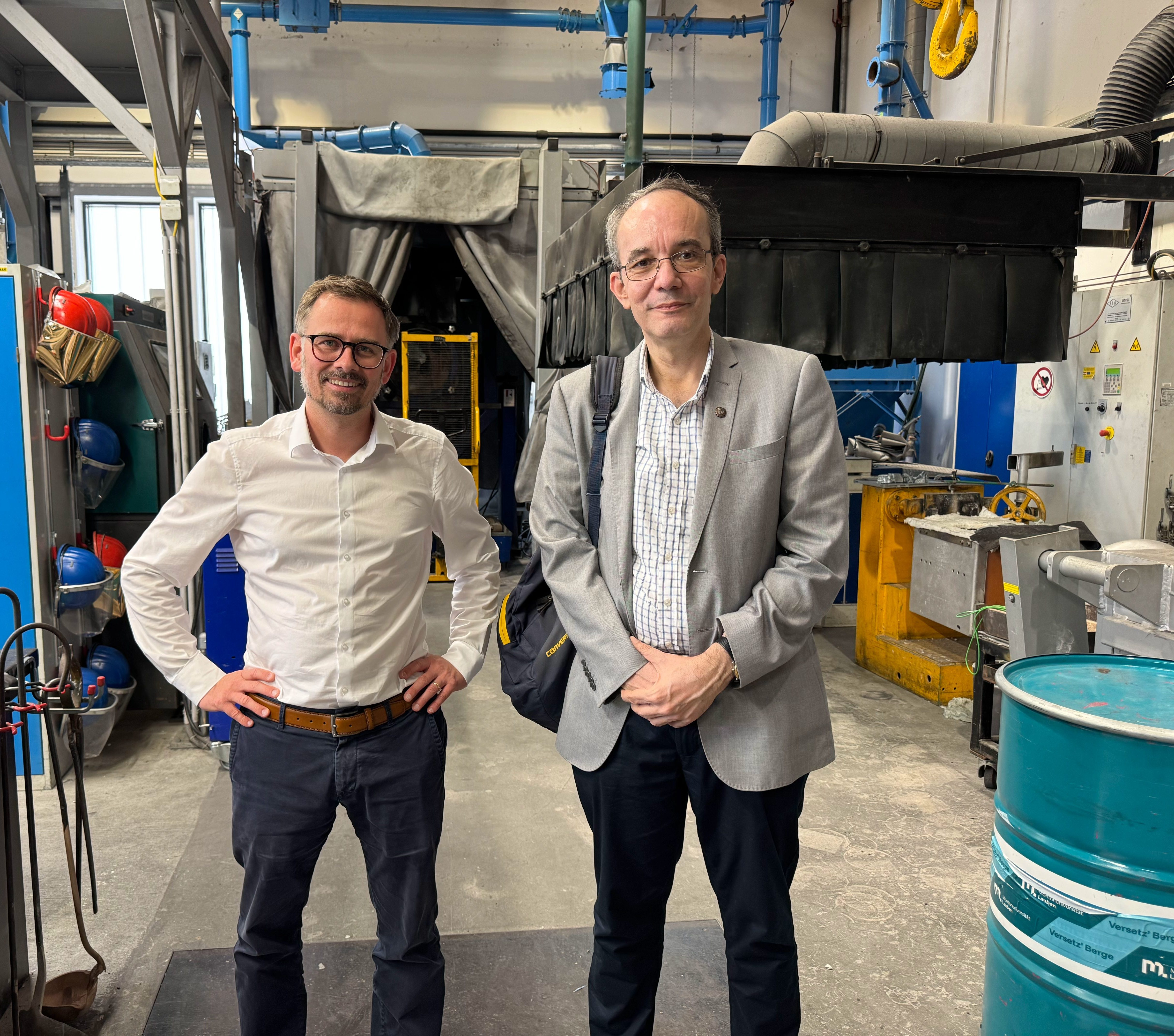
The talk was only one part of a busy and productive visit. Over four days, Professor Djukic toured the Erich Schmid Institute, visited the Chair of General and Analytical Chemistry of Professor Gregor Mori and the Chair of Nonferrous Metallurgy, and sat down with colleagues across Montanuniversität Leoben to explore common research interests and possible future collaborations. Hydrogen and its effects on metals under extreme conditions sit at the heart of our own research programme, so the discussions were as energising as they were relevant.
There could hardly have been a more fitting stage for this visit than the Erich Schmid Institute itself. Named after Erich Schmid — the Austrian physicist whose celebrated law of critical resolved shear stress laid the foundations of modern crystal plasticity — the institute of the Austrian Academy of Sciences has grown into one of Europe’s leading centres for materials science. Sitting at the heart of the materials cluster on the Montanuniversität Leoben campus and led today by Professor Jürgen Eckert and Professor Megan J. Cordill, ESI is renowned worldwide for its work on deformation, fatigue and fracture, micro- and nanomechanics, and severe plastic deformation. Hosting a lecture on how hydrogen reshapes plasticity and fracture in metals, in a house built on Schmid’s legacy of understanding how crystals deform, felt like science coming full circle.
We warmly thank Professor Keckes for making this visit possible, the Austrian Academy of Sciences and the Erich Schmid Institute for hosting it, and above all Professor Djukic for sharing his insight so generously. We very much hope this is the first of many visits — and the start of a lasting collaboration between Leoben and Belgrade.
Postscriptum
This visit builds on a collaboration that is already bearing fruit. Together with Professor Djukic, we have recently published two joint studies: Limitations of Hydrogen Detection After 150 Years of Research on Hydrogen Embrittlement in Advanced Engineering Materials (2024), and Low-energy proton implantation reveals the incipience of hydrogen embrittlement in a martensitic steel in Scripta Materialia (2026). With this visit, we hope the scientific bridge between Belgrade and Leoben will now be significantly strengthened — and that these two papers are only the beginning.
M. A. Tunes, P. J. Uggowitzer, P. Dumitraschkewitz, P. Willenshofer, S. Samberger, F. C. da Silva, C. G. Schön, T. M. Kremmer, H. Antrekowitsch, M. B. Djukic, S. Pogatscher. Limitations of Hydrogen Detection After 150 Years of Research on Hydrogen Embrittlement. Advanced Engineering Materials 26, 2400776 (2024). https://doi.org/10.1002/adem.202400776
D. F. L. Borges, R. O. Silva, I. S. F. Carneiro, N. W. S. Morais, R. L. Sommer, N. R. Checca Huaman, P. J. Uggowitzer, E. Kozeschnik, M. B. Djukic, P. F. P. Fichtner, C. G. Schön, M. A. Tunes. Low-energy proton implantation reveals the incipience of hydrogen embrittlement in a martensitic steel. Scripta Materialia 277, 117238 (2026). https://doi.org/10.1016/j.scriptamat.2026.117238