

What if a single microscope image could simultaneously show nanoclusters, dislocations, grain boundaries, and corrosion pores – all in under a minute? We have found a way to do exactly that and we described recently in a paper published it in Small Methods!
The method, called differential phase contrast (DPC), is not new to electron microscopy — it has been used for decades to image individual atoms and magnetic domains – but we have never really seen it pointed at the messier, more practical scale of real alloy microstructures before. We did exactly that, and the results read almost like a microscopy Swiss Army knife!

DPC works by splitting the low-angle dark-field detector that catches electrons after they pass through a sample into four segments, then comparing the tiny intensity differences between them. Those differences encode the local electric field inside the material, which is converted into a false-colour map — different microstructural features simply show up as different colours. From there, picking out a single colour range lets us isolate just the nanoclusters, or just the dislocations, or just the precipitates, all from one image. We pushed this across five very different aluminium systems: a deformed crossover alloy where we tracked clusters shrinking from 4 nm down to 2 nm with longer ageing, a paint-baked automotive sheet alloy where we caught precipitates nucleating directly along dislocation lines, an overaged aerospace alloy (AA7075) where we told apart four distinct precipitate types by their electric-field signature, an anodised corrosion-resistant coating where we made individual cerium nanoparticles inside the oxide pores visible, and nanocrystalline aluminium films where we used a neural network to map out thousands of individual grains from the DPC contrast.
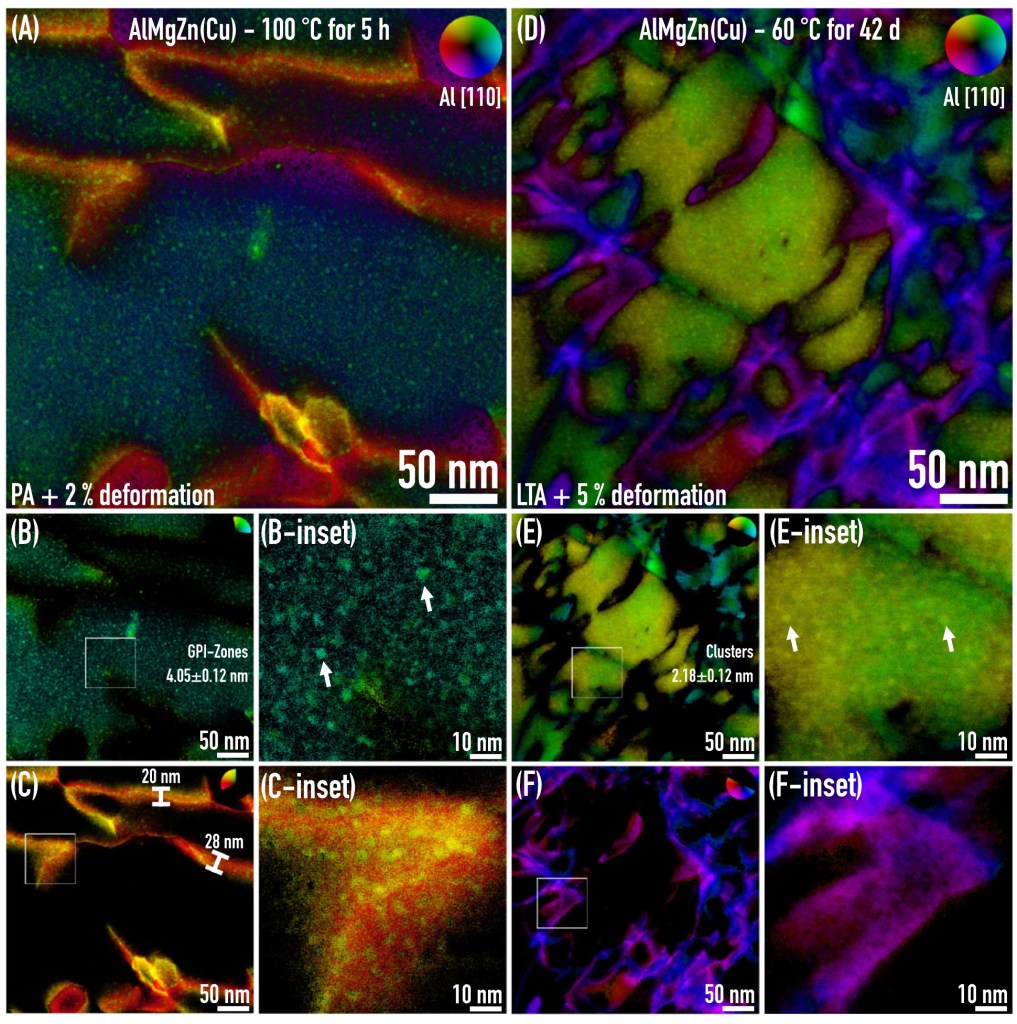
What we find most exciting is just how fast and versatile this approach turns out to be — a single DPC micrograph takes us only about 10–30 seconds to acquire, yet it can be decomposed afterwards to reveal whichever microstructural feature we are chasing. We think this could become a genuinely useful everyday tool for metallurgists working on next-generation alloys, sitting alongside more specialised techniques rather than competing with them.
A final nice touch: we dedicated the paper to Prof. Peter Uggowitzer on his 75th birthday.


