
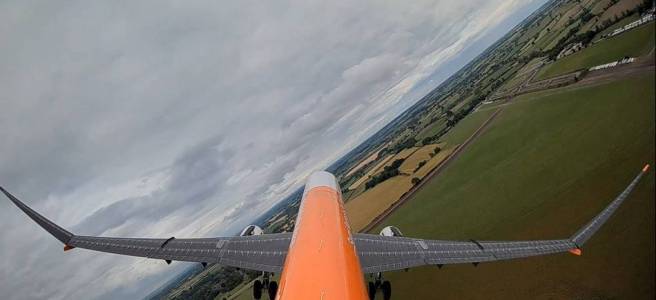
Airbus has just announced the next phase of its Wing of Tomorrow programme: a three-year flight-test campaign, unveiled at Farnborough, that will bolt full-scale wing extensions onto an A321neo to trial the longer, higher-aspect-ratio wings destined for the successor to its best-selling single-aisle family. The extensions are several metres long and stand in for a folding wingtip held in the fully extended cruise position — the trick that lets a much longer, more slender, aerodynamically efficient wing still fold down to fit a standard airport gate. The first demonstrator is due to fly in the second half of 2027. It is a striking piece of engineering, but the detail that ought to catch a materials scientist’s eye is quieter: these wings are made of carbon-fibre composite, not aluminium.
That choice is the whole point. You cannot build a wing this slender and this long out of aluminium alloy and still keep the weight and fatigue life acceptable — the span simply asks for the specific stiffness and tailorable, directional strength that only carbon-fibre reinforced polymer delivers. Widebodies like the A350 and 787 crossed this threshold a decade ago, sitting at roughly half composite by weight, but the single-aisle market was the last redoubt of the aluminium airframe, defended by the brutal economics of building sixty-odd aircraft a month. A folding composite wing on a narrowbody is therefore a signal that composites have won even the argument where aluminium was strongest.
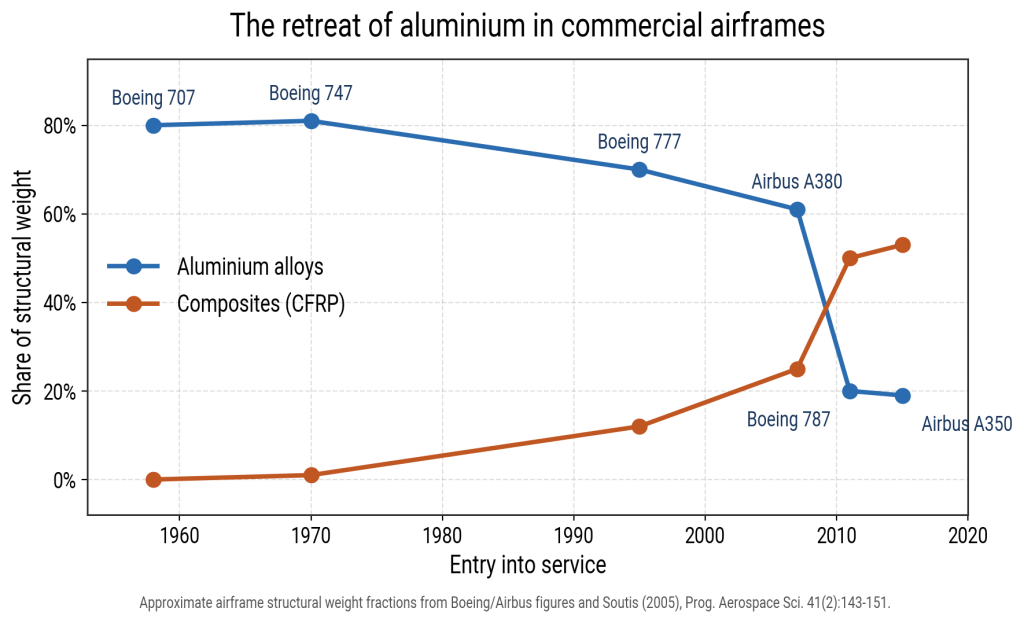
None of this means aluminium alloys are finished, and it is worth being honest about the trade-offs. The 2000- and 7000-series alloys, and their aluminium–lithium (Al-Li) successors, are (relatively) cheap, fast to form, easy to inspect, forgiving to repair and comfortably recyclable — all virtues that matter enormously at high production rate, and all things composites still struggle with. What the Wing of Tomorrow marks is not the death of aluminium but the shrinking of its territory: a century-long incumbency, from the first stressed-skin monoplanes onward, gradually ceding the primary structure to polymer composites wherever aerodynamic performance is worth the cost and complexity. The interesting question now is not whether aluminium retreats, but how far — and whether the metallurgists answer, as they did with Al–Li, with an alloy good enough to hold the line one more time.
The strategic message for the aluminium industry, though, is unambiguous: it will have to start diversifying its portfolio very soon. Leaning on legacy aerospace grades is no longer a safe bet when the highest-value structural applications are migrating to composites, and staying viable in the foreseeable future will mean actively investing in — and accommodating — cutting-edge research in new materials rather than defending existing product lines. That could take many forms: high-performance Al-Li and additively manufactured alloys, aluminium matrix composites, recyclable metal-composite hybrids, or entirely new markets in lightweight structures, energy storage and electrification. The producers who treat this transition as a research-and-development opportunity rather than a threat are the ones likely to still be supplying the aerospace sector a generation from now.
Sources:
[1] Jasper Jolly, “Airbus to test folding wings for next generation of bestselling planes,” The Guardian, 21 July 2026.
[2] Soutis, C. (2005). “Fibre reinforced composites in aircraft construction.” Progress in Aerospace Sciences, 41(2), 143–151. DOI: 10.1016/j.paerosci.2005.02.004


