
Ultrafine-grained (UFG) aluminium alloys are strong candidates for space structures: their dense grain-boundary network acts as sinks that absorb radiation-induced defects (more in our perspective review https://doi.org/10.1021/acsmaterialsau.5c00139). But that advantage only survives if the microstructure does — and in Low-Earth Orbit, sunlit components reach ~200 °C, right where severely deformed aluminium begins to recrystallise.
The real question is when microstructural instability sets in and answering it needs the right probe method
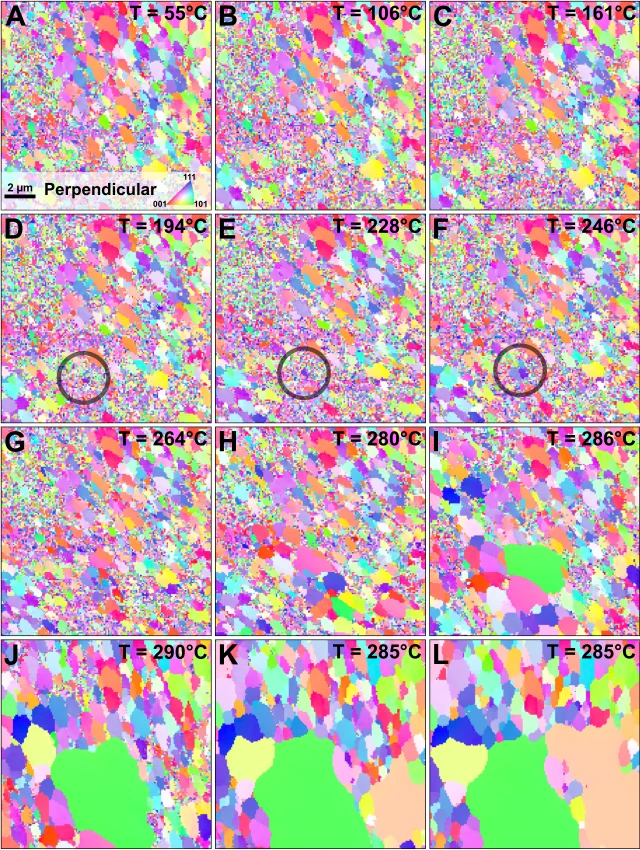
Conventional in situ TEM heating is compromised by thin-film effects that lower transition temperatures, ambiguous grain-boundary contrast and tiny sampling volumes. In a first-of-its-kind correlative comparison of in situ TEM and in situ EBSD heating on a high-pressure-torsion AA6061 (Al–Mg–Si) alloy, we show that EBSD heating samples ~10³ grains from bulk material and cleanly resolves recovery, recrystallisation and grain growth — pinning the onset of instability at ~198 °C, essentially the upper bound of the LEO service window.
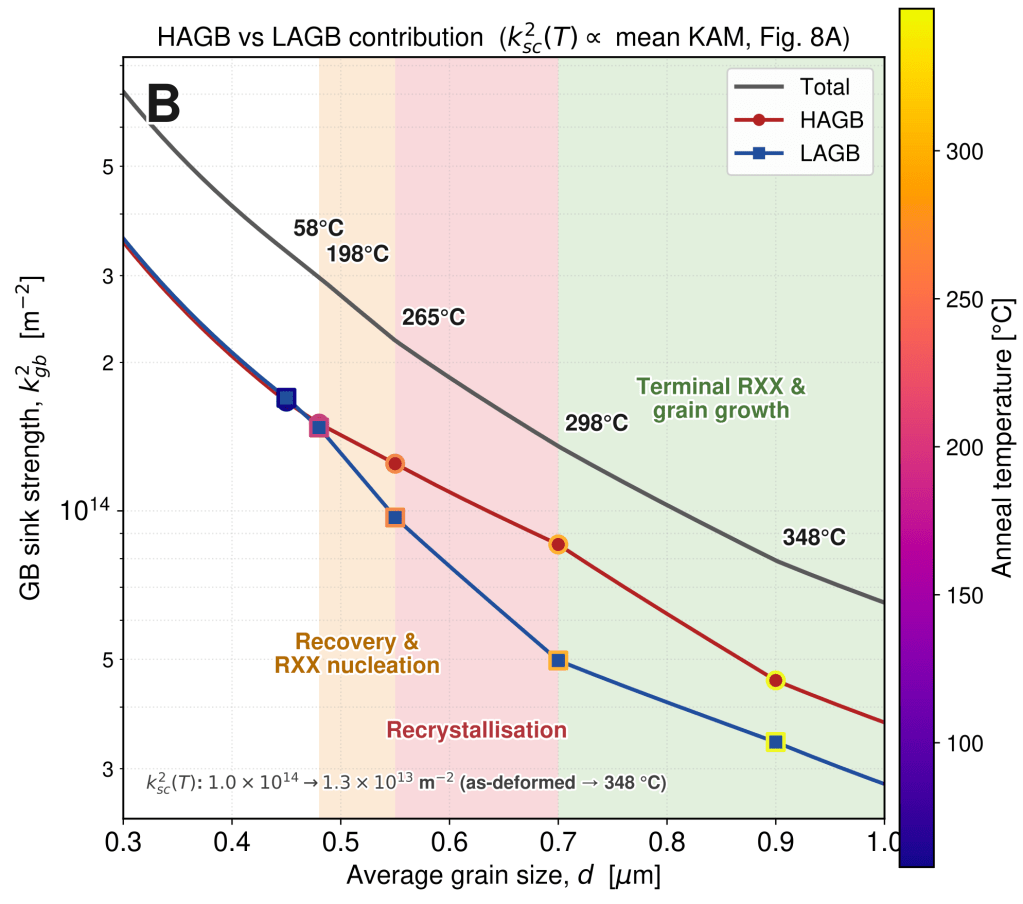
The EBSD data then took us back to a foundational piece of materials physics: the Brailsford–Bullough–Hayns theory of grain-boundary sink strength [1-5], derived in the late 1960s with a fixed internal sink strength. An UFG alloy under thermal load is anything but fixed. Using the live data from the kernel average misorientation (KAM) as a proxy for stored dislocation content, we extended the theory to a temperature-dependent internal sink strength that decays as recovery and recrystallisation consume the deformed structure. Because grain coarsening and dislocation annihilation act together, the sink strength collapses far more steeply than grain growth alone would predict — dropping roughly fourfold across the anneal, with high-angle boundaries taking over from the vanishing sub-boundary network. In short, in situ EBSD did not just test an old theory; it informed a physically grounded revision, turning a static 1960s model into a real-time description of how radiation tolerance degrades.
The verdict is sobering. Precipitation neither delays recrystallisation nor restores strength once the UFG structure is spent — microhardness simply decays — and with instability onset at ~198 °C, inside the operational window, UFG AA6061 is poorly suited to prolonged solar-thermal exposure.
More broadly, the work establishes in situ EBSD heating as a powerful in operando method for the bulk-representative determination of microstructural instabilities in advanced metallic systems for application in extreme environments!
Chapeau Moritz!

This work forms part of the PhD thesis of Moritz Theissing at TU Graz (Institute of Electron Microscopy and Nanoanalysis / Graz Centre for Electron Microscopy, FELMI-ZFE), a brilliant experimental materials physicist.
This preprint/paper marks the very first collaboration between TU Graz and our [X-MAT] team at the Montanuniversität Leoben.
References
[1] A. D. Brailsford, R. Bullough, The rate theory of swelling due to void growth in irradiated metals, Journal of Nuclear Materials 44 (2) (1972) 121–135. doi:10.1016/0022-3115(72)90091-8
[2] A. D. Brailsford, Diffusion to a random array of identical spherical sinks, Journal of Nuclear Materials 60 (3) (1976) 257–278. doi:10.1016/0022-3115(76)90140-9
[3] A. D. Brailsford, R. Bullough, M. R. Hayns, Point defect sink strengths and void-swelling, Journal of Nuclear Materials 60 (3) (1976) 246–256. doi:10.1016/0022-3115(76)90139-2
[4] R. Bullough, M. R. Hayns, M. H. Wood, Sink strengths for thin film surfaces and grain boundaries, Journal of Nuclear Materials 90 (1–3) (1980) 44–59. doi:10.1016/0022-3115(80)90244-5
[5] E. Aradi, M. A. Tunes, J. Lewis-Fell, G. Greaves, H. Antrekowitsch, S. Pogatscher, S. E. Donnelly, J. A. Hinks, Radiation damage suppression in AISI-316 steel nanoparticles: Implications for the design of future nuclear materials, ACS Applied Nano Materials 3 (10) (2020) 9652–9662. doi:10.1021/acsanm.0c01611


