
Producing hydrogen from methane without releasing CO₂ is one of the more promising routes towards a lower-carbon energy system — but the solid carbon coproduct is an equal part of the story. When methane decomposes thermally in a molten tin bath, the carbon that emerges must be characterised, understood, and ultimately valorised if the process is to make economic sense.
We are very pleased to share that our Chair of Nonferrous metallurgy, in collaboration with colleagues from the Chair of Physical Chemistry at MUL, has just published a comprehensive multiscale characterisation of the solid carbon collected from our pilot-scale molten-tin reactor. Led by Dr. Philip Aster, the study brings together combustion analysis, thermogravimetric analysis, Raman spectroscopy, X-ray diffraction, electron microscopy, and BET surface-area measurements to build the most complete picture yet of what this material actually is — in its native, as-collected state, without any post-treatment.
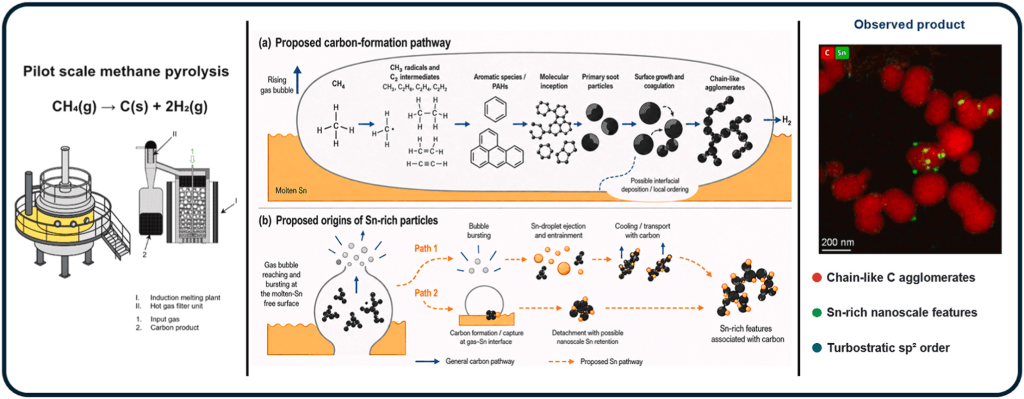
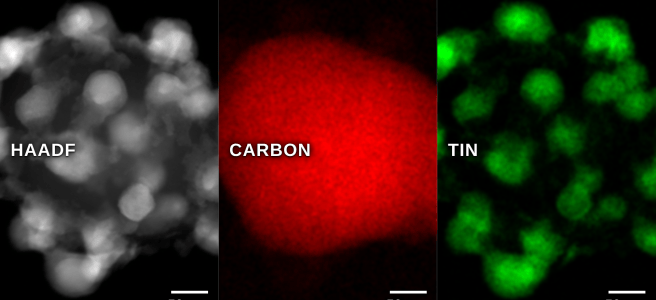
The work establishes that the pilot-scale product is a heterogeneous carbon–tin powder with a turbostratic sp² framework: short, curved graphene-like layers without extended graphitic stacking, decorated by tin-rich features ranging from nanometres to micrometres in scale. The bulk carbon content is approximately 48 wt.-%, and the BET surface area sits at around 12 m² g⁻¹ — consistent with an aggregation-dominated growth mechanism rather than the development of accessible porosity. Dr. Aster has been meticulous in stating exactly what the data can and cannot support, keeping the conclusions honest and the benchmark robust.
This paper is a genuine contribution to the still-sparse body of pilot-scale carbon characterisation data, and it sets the stage for the next steps: (i) quantitative bulk-tin analysis, (ii) controlled purification, and (iii) application testing.
Congratulations to Philip on a carefully crafted and important piece of work. It makes me super happy to have minor contributions to cutting-edge scientific works, such as this one conceptualised led by Dr. Aster!
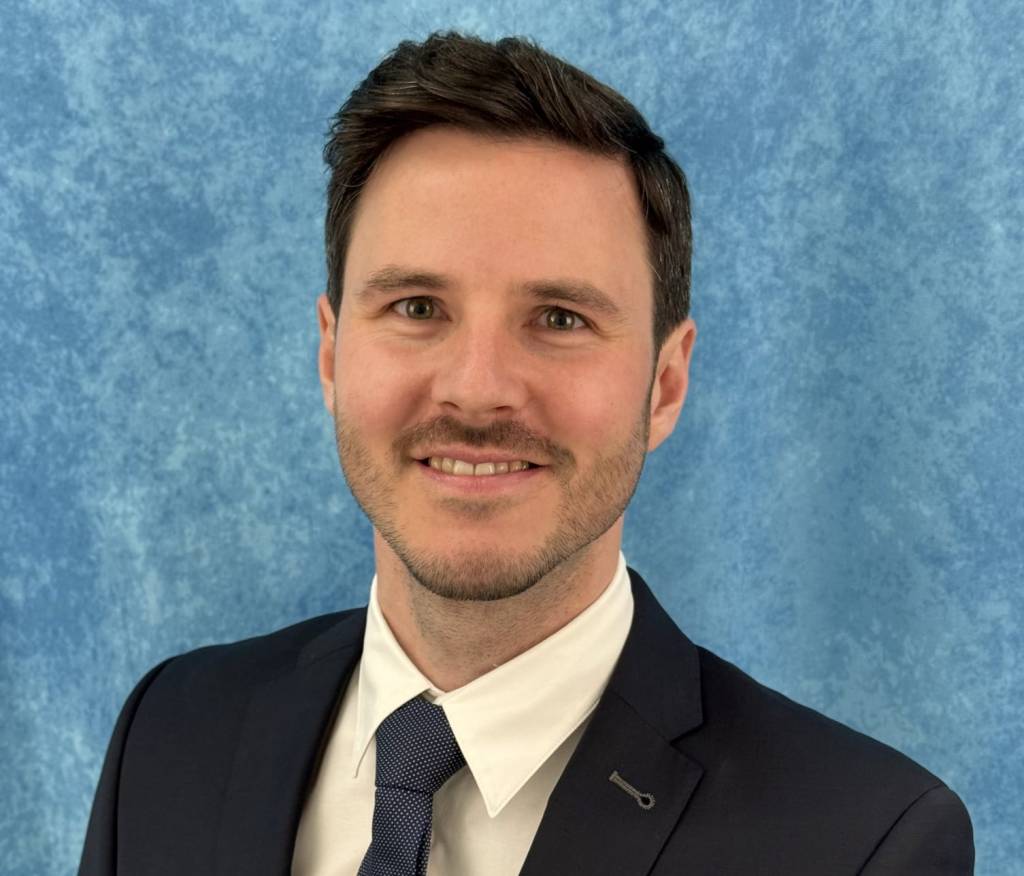
Dipl.-Ing. Dr. mont. Philip Aster, the leader and driver of the study.
Follow his updates on Linkedin: https://lnkd.in/p/dSE6Fvyt
Access the paper here:
Aster P, Scheiblehner D, Leuchtenmüller M, Tunes MA, Berger T, Pichler I, Rameshan C, Antrekowitsch J. Multiscale carbon characterization obtained from methane pyrolysis in a pilot-scale molten metal reactor. International Journal of Hydrogen Energy. 2026;289:158317. https://doi.org/10.1016/j.ijhydene.2026.158317


