
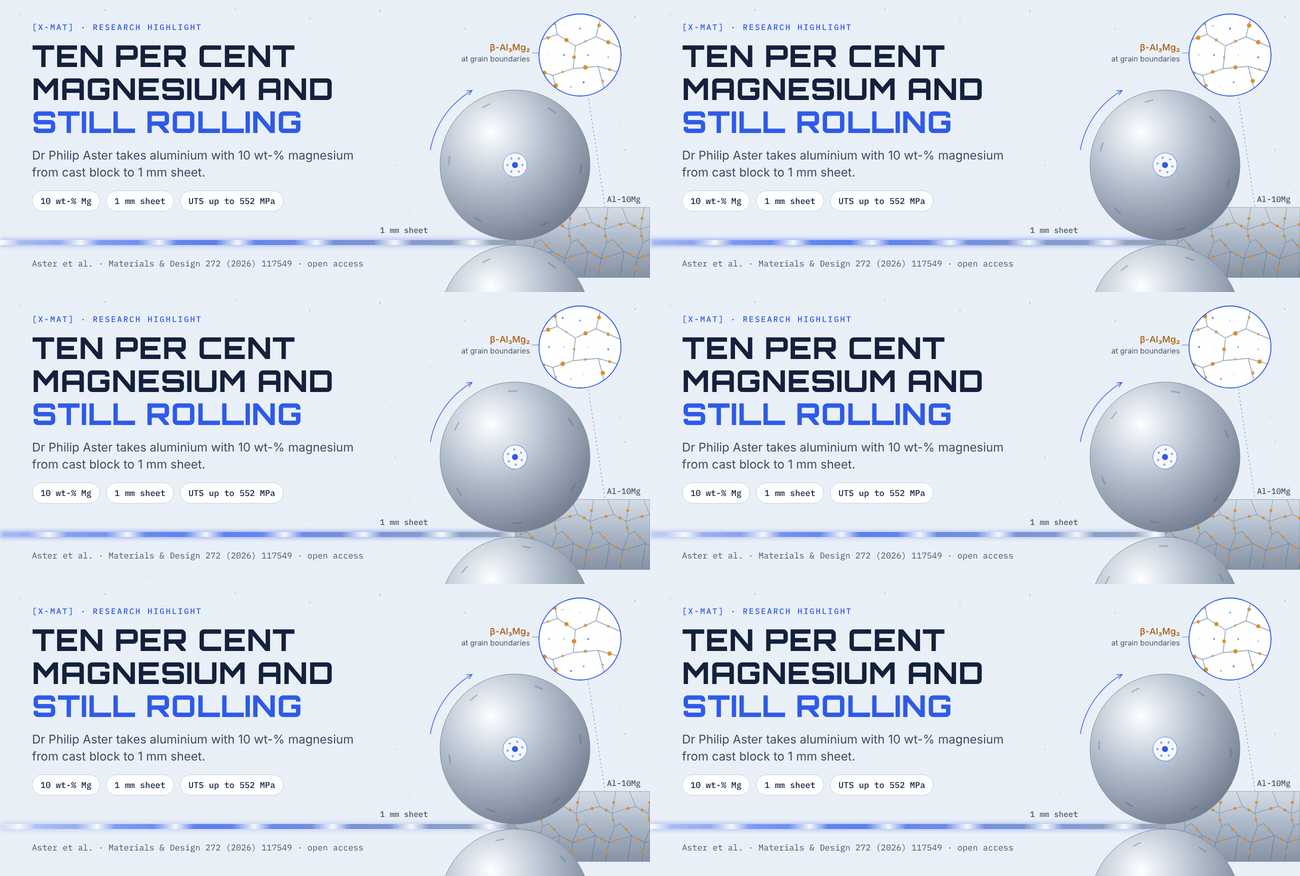
At the close of the nineteenth century, the Austrian Ludwig Mach, son of the physicist Ernst Mach, patented a family of aluminium–magnesium alloys he called Magnalium [1,2]. These were the forerunners of the whole 5xxx series now found in car chassis, ship hulls and rail carriages. More than 125 years later, commercial 5xxx sheet still rarely holds more than 5 to 6 weight per cent magnesium, and not for want of trying. Push the magnesium higher and it segregates during casting, lines the grain boundaries with the brittle β-Al3Mg2 phase and turns rolling into a lottery of edge and surface cracks. In a new open-access paper in Materials & Design, our colleague Dr. Philip Aster show that alloys with around 10 weight per cent magnesium can be taken all the way from a cast block to 1 mm sheet. They do it along two complete routes: one designed in the laboratory and one built with industrial practice in mind.
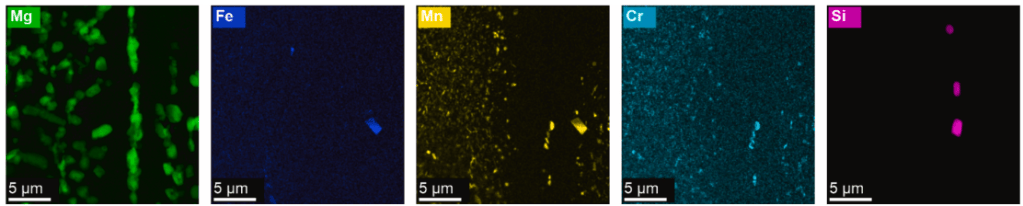
What makes this a magnum opus from Dr. Aster is not a single clever trick but the patience to follow the whole chain, from casting and homogenisation through hot and cold rolling to final annealing, and to explain every step. Dr. Aster identify the end of hot rolling as the decisive gate. Left to cool in air, the sheet lines its grain boundaries with an almost continuous chain of β-Al3Mg2, confirmed by combining scanning transmission electron microscopy, electron diffraction and X-ray diffraction. A further hot-rolling pass followed immediately by a water quench keeps those boundaries largely clean and the material ready for cold rolling.
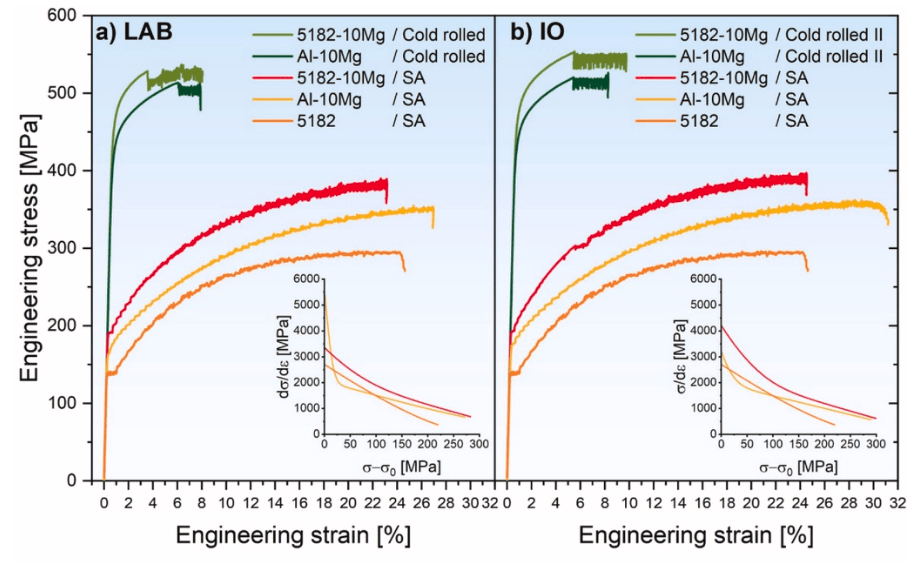
The payoff is striking: cold-rolled sheets reach tensile strengths of up to 552 MPa, and a soft anneal restores elongations above 20 per cent and generous bendability. Comparing a commercial-style 5182-10Mg alloy with a pure binary Al-10Mg alloy gives two distinct sheet concepts, one tuned for strength and the other for forming. Just as admirable is the authors’ candour. They state plainly that the air-cooled and water-quenched states also differ in rolling history, so the result defines a processing gate rather than a critical cooling rate. They are equally clear that uses in transport, marine structures or lightweight protection will still need testing for corrosion, fatigue, joining and impact. We are proud to have played a part in this work, and we warmly encourage everyone to read it.
About the scientist and first- and led-author

Dr. Philip Aster is a senior scientist at the Chair of Nonferrous Metallurgy, Montanuniversität Leoben. His work centres on clustering, precipitation and strain hardening in aluminium alloys, from Cu-modified Al–Mg–Si alloys and Al–Mg–Zn–(Cu) crossover alloys to high-magnesium 5xxx sheet. He completed his PhD in late 2024, and he received an Acta Student Award, one of the most prestigious distinctions for early-career researchers in metallurgy and materials science.
Dr Aster’s papers on aluminium metallurgy have a habit of changing how both researchers and industry think about these alloys, and this one is no exception. I am extremely honoured to do metallurgy research with him!
Read the paper (open access)
Aster P., Samberger S., Weidinger A., Schmid F., Brandner C., Kremmer T., Tunes M.A., Gammer C., Pogatscher S., Weißensteiner I., 5xxx-10 wt-% Mg rolled sheets: processability and potential, Materials & Design, 272, 117549, 2026. https://doi.org/10.1016/j.matdes.2026.117549
References
[1] Mach L., Aluminium-Magnesium-Legirung, German patent DE 105502, 1898. https://patents.google.com/patent/DE105502C/de
[2] Mach L., Process of making aluminium alloys, US patent 662,952, 1900. https://patents.google.com/patent/US662952


